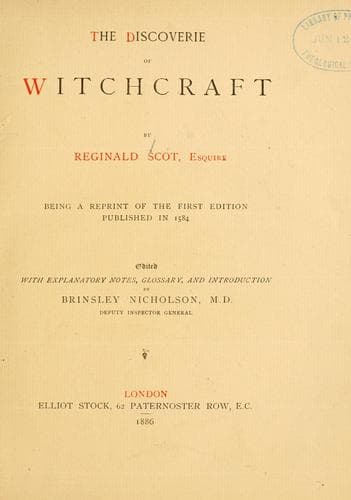
Demonology -- Early works to 1800; Magic -- Early works to 1800; Witchcraft -- Early works to 1800
My greatest adversaries are yoong ignorance and old custome. For what
follie soever tract of time hath fostered, it is so superstitiouslie
pursued of some, as though no error could be acquainted with custome.
But if the lawe of nations would joine with such custome, to the
maintenance of ignorance, and to the suppressing of knowledge; the
civilest countrie in the world would soone become barbarous, &c. For
as knowledge and time discovereth errors, so dooth superstition and
ignorance in time breed them. And concerning the opinions of such, as
wish that ignorance should rather be mainteined, than knowledge busilie
searched for, bicause thereby offense may grow: I answer, that we are
commanded by Christ himselfe to search for knowledge: for it is the
kings honour (as Salomon saith) to search out a thing.
♦John. 5.♦
♦Prov. 15, 1.♦
Aristotle said to Alexander, that a mind well furnished was more
beautifull than a bodie richlie araied. What can be more odious to
man, or offensive to God, than ignorance: for through ignorance the
Jewes did put Christ to death. Which ignorance whosoever forsaketh, is
promised life everlasting: and therfore among Christians it should be
abhorred above all other things. For even as when we wrestle in the
darke, we tumble in the mire, &c: so when we see not the truth, we
wallow in errors. A blind man may seeke long in the rishes yer he find
a needle; and as soone is a doubt discussed by ignorance. Finallie,
truth is no sooner found out in ignorance, than a sweet savor in a
dunghill. And if they will allow men knowledge, and give them no leave
to use it, men were much better be without it than have it. For it is,
as to have a tallent, and to hide it under the earth; or to put a
candle under a bushell: or as to have a ship, & to let hir lie alwaies
in the docke: which thing how profitable it is, I can saie somewhat by
experience.
♦Acts. 3.
Proverbs. 9.♦
♦Matth. 25.
Matth. 5.
Luke. 8.♦
But hereof I need saie no more, for everie man seeth that none can
be happie who knoweth not what felicitie meaneth. For what availeth
it to have riches, and not to have the use thereof? Trulie the
heathen herein deserved more commendation than manie christians, for
they spared no paine, no cost, nor travell to atteine to knowledge.
Pythagoras travelled from Thamus to Aegypt, and afterwards into Crete
and Lacedæmonia: and Plato out of Athens into Italie and Aegypt, and
all to find out hidden secrets and knowledge: which when a man hath,
he seemeth to be separated from mortalitie. For pretious stones, and
all other creatures of what value soever, are but counterfeits to
this jewell: they are mortall, corruptible, and inconstant; this is
immortall, pure and certeine. Wherfore if I have searched and found
out any good thing, that ignorance and time hath smothered, the same I
commend unto you: to whom though I owe all that I have, yet am I bold
to make other partakers with you in this poore gift.
Public-domain text, read in full here on John Shaqi.
Reviews
Reviews
No reviews yet
Be the first to share your thoughts on this work.
Join the Discussion
Join the discussion
Sign in to leave a comment or review.
Sign InorCreate an account