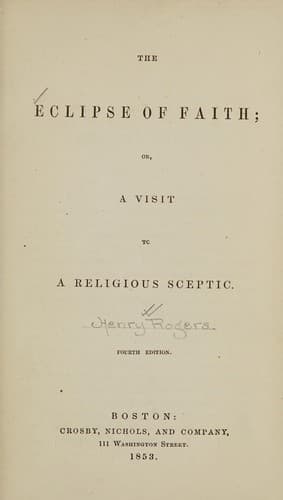
The Eclipse of Faith; Or, A Visit to a Religious ScepticRogers, Henry
Religion
The Eclipse of Faith; Or, A Visit to a Religious Sceptic
Rogers, Henry
Skepticism -- Controversial literature
I told him I was afraid I must run the risk of appearing in his
eyes "grossly disingenuous"; not that I deemed it necessary to
maintain that the Apostles had any idea of the period of time which
was to intervene between the first promulgation of the Gospel and
the consummation of all things; for when I found our Lord himself
acknowledging, "Of that day and that hour knoweth no man, not even
the angels, nor even the Son, but the Father only," I could not
wonder that the Apostles were left to mere conjectures on a subject
which was then veiled even from his humanity. I said I even thought
it probable that their vivid feeling anticipated the day,--that the
interval between, so to speak, was "foreshortened" to them; but that
I could not see how the question of their inspiration, or the
truth of Christianity, was at all involved in their ignorance on
that point; unless, indeed, it could be proved that they had
positively stated that the predicted event would take place in their
own time. This, I acknowledged, I could not find,--but much to the
contrary; that the charge, indeed, had been so often repeated by
the infidel school, that they had persuaded themselves of it, and
spoke of it as if it were a decided point; but that as long as the
second Epistle of St. Paul to the Thessalonians remained, in which
the Apostle expressly corrected misapprehensions similar to those
which infidelity still professes to found on the first Epistle, I
should continue to doubt whether Paul did not know his own mind
better than his modern commentators. I told him that we do not
hear that the Thessalonians persisted in believing that they had
rightly interpreted Paul's words after he had himself disowned the
meaning they had put upon them; that this was a degree of assurance
only possible to modern critics; and that I was surprised that
Mr. Newman should have quietly assumed the alleged "mistake" in
his "Phases of Faith," without thinking it worth while even to state
the opposing argument from the Second Epistle. I added, that the
repeated references which both Paul and Peter make to their own
deaths, as certain to take place before the dissolution of all
things, sufficiently prove that, however their view of the future
might be contracted, they did not expect the world to end in their
day, and ought to have silenced the perverse criticism on the
popular expression, "Then we which are alive and remain," &c.
Having briefly stated my opinion, Fellowes said he saw that he and
I were as little likely to agree as Harrington and he. "However," he
continued, turning to his friend, "to go back to the point from which
we digressed. My new faith, at all events, makes me happy, which it
is plain--too plain--that your want of all faith does not make you."
Public-domain text, read in full here on John Shaqi.
Reviews
Reviews
No reviews yet
Be the first to share your thoughts on this work.
Join the Discussion
Join the discussion
Sign in to leave a comment or review.
Sign InorCreate an account