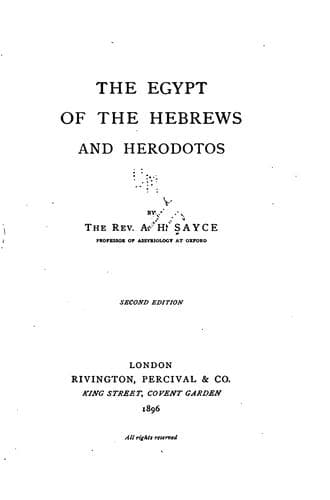
The Egypt of the Hebrews and HerodotosSayce, A. H. (Archibald Henry)
History
The Egypt of the Hebrews and Herodotos
Sayce, A. H. (Archibald Henry)
Egypt -- History, Ancient
Freed from the necessity of defending his own territories, Ramses now
carried the war into Asia. What in later days was the land of Judah was
overrun by his forces; Gaza and the districts round Hebron and Salem or
Jerusalem were occupied, and the name of the Dead Sea appears on the walls
of Medînet Habu for the first time in Egyptian history. The Egyptian army
even crossed to the eastern side of the Jordan and captured the Moabite
capital.
Another campaign led it along the Phœnician coast into northern Syria.
Hamath was taken, and Ramses seems to have penetrated as far as the slopes
of the Taurus. He even claims to have defeated the people of Mitanni or
Aram-Naharaim on the eastern bank of the Euphrates. The kings of the
Hittites and the Amorites, like the chiefs of the Zakkur and the
Philistines, were already prisoners in his hands.
But the northern campaigns of Ramses were intended to strike terror rather
than to re-establish the Asiatic empire of Egypt. No attempt was made to
hold the cities and districts which had been overrun. Though a temple was
erected to Amon on the frontiers of the later Judæa, even Gaza was given
up, and the fortress which had so long defended the road from Canaan into
Egypt was allowed to pass into Philistine hands. It was the same with the
campaign which the Pharaoh conducted at a later date against the “Shasu”
or Bedouin of Edom. For the first time an Egyptian army succeeded in
making its way into the fastnesses of Mount Seir, slaying the warriors of
Edom, and plundering their “tents.” The Edomite chief himself was made a
prisoner. The expedition had the effect of protecting the Egyptian mining
establishments in the Sinaitic peninsula as well as the maritime trade
with southern Arabia. Large quantities of malachite were brought year by
year from the Egyptian province of Mafka or Sinai, and the
merchant-vessels of Ramses coasted along the Red Sea, bringing back with
them the precious spices of Yemen and Hadhramaut.
Ramses III. died after a reign of more than thirty-two years, and the
military renown of Egypt expired with him. His exact date is still a
matter of doubt, but his accession must have fallen about B.C. 1200. The
date is important, not only because it closes the history of Egypt as a
conquering power, but also as it marks a great era of migration among the
northern populations of the Mediterranean, as well as the permanent
settlement of the Philistines in Palestine. It was, moreover, the period
to which the Israelitish invasion of Canaan must belong.
Public-domain text, read in full here on John Shaqi.
Reviews
Reviews
No reviews yet
Be the first to share your thoughts on this work.
Join the Discussion
Join the discussion
Sign in to leave a comment or review.
Sign InorCreate an account