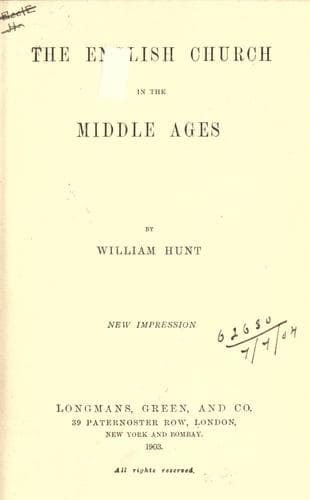
The English Church in the Middle Ages — John Shaqi
The English Church in the Middle AgesHunt, William
History
The English Church in the Middle Ages
Hunt, William
Church history -- Middle Ages, 600-1500; Great Britain -- Church history
All the foreign bishops, Normans and Lotharingians alike, were accustomed
to greater dependence on Rome than had ever been owned in England, and the
effect of their appointment was to weaken the national character of the
Church. We now for the first time find bishops, after they had been
nominated by the king, going to Rome for confirmation, and the Roman court
claiming to have the right to reject a royal nomination. Various matters,
too, were now referred to the Pope for decision, contrary to the custom of
the English Church. Other foreign fashions were also introduced. In
England, any place was chosen for a bishop's see that was a convenient
centre for diocesan work; on the Continent, bishops always had their sees
in cities. Leofric, bishop of Crediton, a Lotharingian by education though
not by birth, naturally had foreign ideas, and wished to transfer his see
from the village of Crediton to the city of Exeter. He did not first apply
to the king for leave to make this change, as any of his predecessors
would have done, but asked Pope Leo IX. for his sanction. Leo wrote to
Eadward expressing his surprise that Leofric should have "a see without a
city," and requesting that the change should be made. At the same time,
the removal was actually effected in virtue of a charter granted by the
king in 1050 with the consent of the witan. When, after the Conquest,
foreigners were dominant in the Church, the translation of sees from
villages to cities was, as we shall see, widely carried out. Leofric also
made the clergy of his cathedral conform to a rule observed by canons in
Lotharingia, called the rule of Chrodegang of Metz; he would not allow
them to live in their own houses, and forced them to sleep in a common
dormitory and eat at a common table. This gave his chapter a character
that was half monastic and half secular, and, of course, prevented the
clergy from living as married men. The system was introduced at Wells by
the Lotharingian bishop Gisa, and, with some modifications, at York by
Ealdred; but it never took root in England. The influence of the foreign
prelates may also be traced in the presence of English bishops at papal
councils. Several attended the council which Leo held at Rheims in 1049,
and also his council at Vercelli the next year. At Vercelli, Ulf sought
the papal confirmation of his appointment to the bishopric of Dorchester,
and, we are told, "they were very nigh breaking his staff," because he
could not perform the Service of the Church. Nevertheless, ignorant as he
was, he was allowed to keep his office; for he spent a large sum in
bribery.
[Sidenote: Party struggles.]
Public-domain text, read in full here on John Shaqi.
Reviews
Reviews
No reviews yet
Be the first to share your thoughts on this work.
Join the Discussion
Join the discussion
Sign in to leave a comment or review.
Sign InorCreate an account