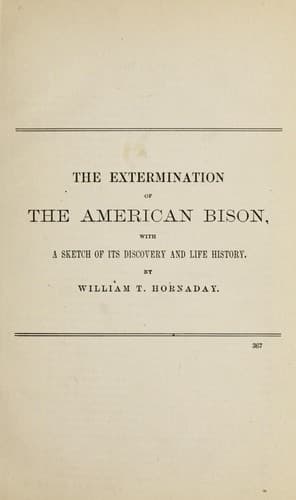
The Extermination of the American Bison — John Shaqi
The Extermination of the American BisonHornaday, William T. (William Temple)
History
The Extermination of the American Bison
Hornaday, William T. (William Temple)
American bison; Wildlife conservation -- United States -- Sources
It was a fixed habit with the great buffalo herds to move southward from
200 to 400 miles at the approach of winter. Sometimes this movement was
accomplished quietly and without any excitement, but at other times it
was done with a rush, in which considerable distances would be gone over
on the double quick. The advance of a herd was often very much like that
of a big army, in a straggling line, from four to ten animals abreast.
Sometimes the herd moved forward in a dense mass, and in consequence
often came to grief in quicksands, alkali bogs, muddy crossings, and on
treacherous ice. In such places thousands of buffaloes lost their lives,
through those in the lead being forced into danger by pressure of the
mass coming behind. In this manner, in the summer of 1867, over two
thousand buffaloes, out of a herd of about four thousand, lost their
lives in the quicksands of the Platte River, near Plum Creek, while
attempting to cross. One winter, a herd of nearly a hundred buffaloes
attempted to cross a lake called Lac-qui-parle, in Minnesota, upon the
ice, which gave way, and drowned the entire herd. During the days of the
buffalo it was a common thing for voyagers on the Missouri River to see
buffaloes hopelessly mired in the quicksands or mud along the shore,
either dead or dying, and to find their dead bodies floating down the
river, or lodged on the upper ends of the islands and sand-bars.
Such accidents as these: it may be repeated, were due to the great
number of animals and the momentum of the moving mass. The forced
marches of the great herds were like the flight of a routed army, in
which helpless individuals were thrust into mortal peril by the
irresistible force of the mass coming behind, which rushes blindly on
after their leaders. In this way it was possible to decoy a herd toward
a precipice and cause it to plunge over en masse, the leaders being
thrust over by their followers, and all the rest following of their own
free will, like the sheep who cheerfully leaped, one after another,
through a hole in the side of a high bridge because their bell-wether
did so.
Public-domain text, read in full here on John Shaqi.
Reviews
Reviews
No reviews yet
Be the first to share your thoughts on this work.
Join the Discussion
Join the discussion
Sign in to leave a comment or review.
Sign InorCreate an account