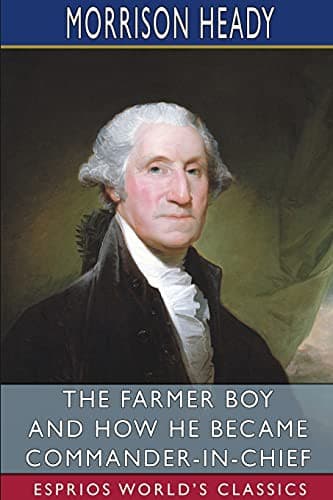
The Farmer Boy, and How He Became Commander-In-ChiefHeady, Morrison
History
The Farmer Boy, and How He Became Commander-In-Chief
Heady, Morrison
Washington, George, 1732-1799
"In the first place, Dannie," said Uncle Juvinell, "for the benefit of
the rest of the children, who are not so well informed upon such
matters as yourself, we must see what a midshipman is. The lowest
officer in the navy, but still several degrees removed from a common
sailor, is a midshipman, who enters a man-of-war as a kind of pupil
to study the art of navigation, and to acquaint himself with other
matters connected with the seafaring life. A man-of-war, you must
know, is the largest vessel, or ship of war, belonging to a nation;
while all the ships fitted out at the public expense, together with
the officers and seamen concerned in their keeping and management,
make up what is called a navy. By navigation, we are to understand the
art by which sailors are taught to conduct ships from one point to
another. Now, a warrant is a writing that gives some one the right to
do a thing or to enjoy it. Thus you see a midshipman's warrant would
have given young Washington the right to go on board a man-of-war,
where, as a kind of pupil, he would have learned the art of
navigation, the management of ships, and many other things necessary
to make a good sailor. The knowledge thus acquired, and the training
to which he must needs have been subjected, would have fitted him in
time to become an officer of the navy, such as a lieutenant or a
captain, and, it may be, even an admiral."
"And what is an admiral?" inquired Willie.
"An admiral," replied Uncle Juvinell, "is the highest officer of the
navy; he is to the armies of the sea what a general is to the armies
of the land, and commands a squadron, or fleet, which, you must know,
is a large number of armed ships, moving and acting in concert
together."
"Does he fight with a sword?" inquired Bryce, who, it must be borne in
mind, was the military young gentleman, who carried a wooden sword of
his own.
"It is unusual," replied his uncle, "for either an admiral or a
general to fight in person; it being their duty to put their armies in
order of battle, and afterwards, during the fight, to control the
movements of the different regiments or divisions by orders carried by
aides to the officers under their command."
"You told us, uncle," said Willie, "that Washington received, along
with the commission of adjutant-general, the rank of major. Now, what
are we to understand by this?"
"A commission," replied his uncle, "is a writing, giving some one the
right or authority to perform the duties of some office, and receive
the pay and honors arising from the same. The duties of an
adjutant-general you have already seen; and the commission received by
young Washington to perform those duties made him equal in rank, not
to a general, but to a major."
"I know you told us, uncle," said Ella, "what is meant by surveying;
but I don't think that I clearly understand it yet."
Public-domain text, read in full here on John Shaqi.
Reviews
Reviews
No reviews yet
Be the first to share your thoughts on this work.
Join the Discussion
Join the discussion
Sign in to leave a comment or review.
Sign InorCreate an account