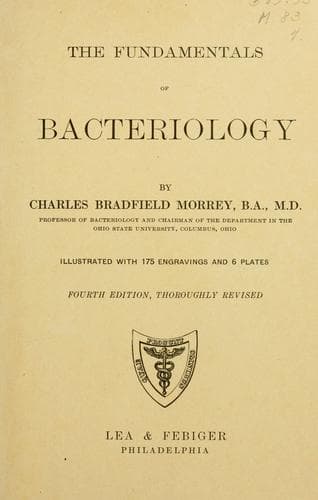
The Fundamentals of BacteriologyMorrey, Charles Bradfield
Science
The Fundamentals of Bacteriology
Morrey, Charles Bradfield
Bacteriology
Under ordinary conditions the carbohydrate is never completely
fermented, since the accumulation of the product--acid--stops
the reaction. If the acid is neutralized by the addition of an
alkali--calcium or magnesium carbonate is best--then the sugar
may all be split up. Where such fermentation occurs under natural
conditions, the products are further split up, partly by molds and
partly by acid-destroying bacteria into simpler acids and eventually
to carbon dioxide and water, so that the end-products of the complete
fermentation of carbohydrate material in nature are carbon dioxide,
hydrogen, marsh gas, and water.
In all of these fermentations the bacteria are utilizing the _carbon_
both as building material and for oxidation and the fermentations
are incidental to this use. As a rule, the acid-forming bacteria can
withstand a higher concentration of acid than the other bacteria that
would utilize the same material, and in a short time crowd out their
competitors or inhibit their growth, and thus have better conditions
for their own existence, though finally their growth is also checked by
the acid.
SPLITTING OF FATS.
The _splitting of fats_ into glycerin and the particular acid or
acids involved may be brought about by bacteria. An illustration
is the development of rancidity in butter at times and the
“strong” odor of animal fats on long keeping and of many kinds of
cheese--“limburger”--in this country. Generally speaking, however, fats
are not vigorously attacked, as is illustrated by the difficulties due
to accumulation of fats in certain types of sewage-disposal works. The
chemical change is represented by the equation:
Fat. Glycerin. Fatty acid.
C₃H₅(C{_n_}H₂{_n_}₋₁O₂)₃ + 3 H₂O = C₃H₅(OH)₃ + 3 (C{_n_}H₂{_n_}O₂).
CHAPTER X.
PHYSIOLOGICAL ACTIVITIES (CONTINUED).
PUTREFACTION OF PROTEINS.
The word “_putrefaction_” is now restricted to the action of bacteria
on the _complex nitrogen-containing substances_, proteins, and their
immediate derivatives. The process is usually accompanied by the
development of foul odors.
Bacteria make use of proteins chiefly as a source of nitrogen, but also
as a source of carbon and other elements. Proteins contain nitrogen,
carbon, hydrogen, oxygen, sulphur and frequently phosphorus. Some of
the metals--potassium, sodium, calcium, magnesium, iron and manganese
and the non-metal chlorine--are nearly always associated with them more
or less intimately. Since these bodies are the most complex of natural
chemical substances it follows that the breaking up of the molecule to
secure a part of the nitrogen gives rise to a great variety of products.
Public-domain text, read in full here on John Shaqi.
Reviews
Reviews
No reviews yet
Be the first to share your thoughts on this work.
Join the Discussion
Join the discussion
Sign in to leave a comment or review.
Sign InorCreate an account