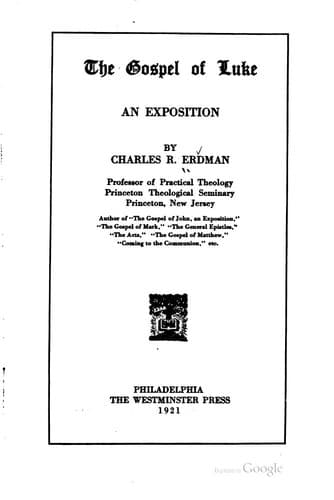
The Gospel of Luke, an expositionErdman, Charles Rosenbury
Religion
The Gospel of Luke, an exposition
Erdman, Charles Rosenbury
Bible. Luke -- Commentaries
Leprosy was regarded as the most loathsome and terrible of diseases. It
existed in various forms but its invariable feature was its foul
uncleanness. The leper was an outcast; he was compelled to live apart from
the dwellings of men. He was required to wear a covering over his mouth
and to give warning of his approach by crying, “Unclean! Unclean!” His
case was regarded as hopeless; he was reckoned as dead. Loathsome,
insidious, corrupting, pervasive, isolating, ceremonially and physically
defiling, surely leprosy is a fitting emblem of sin; and this graphic
narrative presents a parable of the power of Christ to cleanse and to heal
and to restore. It is a vivid picture which Luke draws; the humble trust
of the poor sufferer, his pitiful cry, the sympathetic touch of Jesus, the
word of command and the instant cure. While Jesus forbade the man to
arouse excitement by telling of his healing, he commanded him to report
his case to the priest, that the highest religious authorities might have
unanswerable testimony to the divine power of Christ, and also that the
man might bring the offerings required by the Law and thus express his
gratitude to God. Our Master does expect all who have felt his healing
touch to testify of his grace and to show their gratitude by offering to
him the service of their lives.
Such miracles could not be hid. The crowds so pressed upon Jesus that he
was forced to withdraw to the desert for rest; and as the scene closed he
who had startled the multitude by the manifestation of his divine power
was left alone seeking help from God in prayer.
3. Jesus Forgiving Sins. Ch. 5:17-26
Public-domain text, read in full here on John Shaqi.
Reviews
Reviews
No reviews yet
Be the first to share your thoughts on this work.
Join the Discussion
Join the discussion
Sign in to leave a comment or review.
Sign InorCreate an account