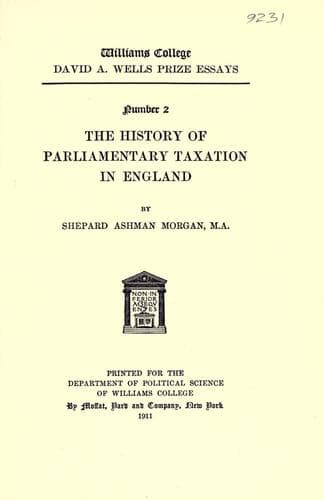
The History of Parliamentary Taxation in EnglandMorgan, Shepard Ashman
History
The History of Parliamentary Taxation in England
Morgan, Shepard Ashman
Taxation -- Great Britain; Taxation -- Great Britain -- History
The time was at hand, however, when the period of transition to the
impersonal relation should begin,--the relation which exists between
representatives of the nation and the government as personified in the
king, the relation recognizable to-day between the layers of taxes and
the spenders of the proceeds of taxation.
[Knights of the shires called to the Council, 1254]
In 1254, during Henry’s absence in Gascony, the regents, Queen Eleanor
and Earl Richard Cornwall, took steps to amplify the Council for the
time being with the lesser feudal tenants for the purpose of laying
taxes.[105] John, at his St. Albans Council in 1213, had had recourse
to a similar expedient, though the principle involved was quite
different. In the earlier instance a representative reeve and four men
from each township and the royal demesne were summoned in order to
assess the amount due in restitution to the clergy. In the latter the
royal writs directed that from each of the counties two “lawful and
discreet knights” be sent up to Westminster, “who together with the
knights from the other counties whom we have had summoned for the same
day, shall arrange what aid they are willing to pay us in our need.”
The knights were to be chosen by the counties themselves, probably in
the county court, since there the machinery of election already was in
existence. The election of knights by the body of suitors who composed
the courts of the counties was by no means a new thing; for eighty
years there is evidence of the election of such representatives for
local purposes, and it would be no startling innovation to extend this
function of the courts to the election of representatives in a national
council. In the present instance, furthermore, there is in the writ an
implication, though the deduction is hazardous, that the matter of the
aid received previous consideration in the county courts themselves.
“And you yourself carefully set forth to the knights and others of the
said counties,” so continues the instructions to the sheriff, “our
need and how urgent is our business, and effectually persuade them to
pay us an aid sufficient for the time being; so that the aforesaid ...
knights at the aforesaid time shall be able to give definite answer
concerning the said aid to the aforesaid council, for each of the said
counties.” The upshot of this Council was disappointing to the crown;
nothing resulted except a renewal of complaints against the royal
administration. Simon de Montfort, whose position as the defender
of the rights of Parliament, was as yet quite misapprehended, took
occasion to warn the Council against the policy of the king.[106]
Public-domain text, read in full here on John Shaqi.
Reviews
Reviews
No reviews yet
Be the first to share your thoughts on this work.
Join the Discussion
Join the discussion
Sign in to leave a comment or review.
Sign InorCreate an account