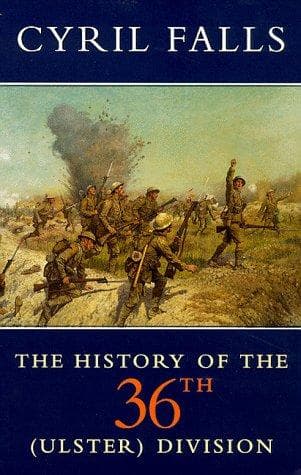
The History of the 36th (Ulster) DivisionFalls, Cyril
History
The History of the 36th (Ulster) Division
Falls, Cyril
Great Britain. Army. Division, 36th; World War, 1914-1918 -- Regimental histories -- Great Britain
The artillery consisted of the 36th Divisional Artillery, one
Brigade of the 49th Division, a Regiment of French Artillery, and,
under the orders of the X. Corps, a greater concentration of heavy
artillery than had been made in the course of the war till now,
except perhaps in the latter stages of Verdun. The preliminary
bombardment was to last five days, from the 24th to the 28th of June.
Owing to wet weather the attack was postponed two days, and there
were two extra days of bombardment. The results, as witnessed from
our observation posts, were magnificent. All wire that could be seen
was effectively cut. As one watched the big shells bursting, sending
up huge columns of earth, day after day, it appeared as though no
life could continue in that tortured and blasted area. The barrage
for the attack was not the true "creeping barrage" which was to
become universal later on, and was, indeed, employed that day by the
French. After a final intensive bombardment of sixty-five minutes, it
fired upon each German line in succession, lifting from the "A" to
the "A.I." at Zero, from the "A.I." at Zero plus three minutes, from
the "B" at Zero plus eighteen minutes, to a line 400 yards east of
this objective. Then at Zero plus twenty-eight minutes it moved on to
the "C" line, and at Zero plus one hour eighteen minutes off the "C"
line to the "D." There was then a long halt to permit of the passing
through of the 107th Brigade. At Zero plus two hours thirty-eight
minutes the barrage moved up to a line three hundred yards east of
the "D" line. At each lift, sections of 18-pounders and 4.5 howitzers
"walked up" the communication trenches to the next barrage line.
Stokes mortars were to take part in a final hurricane bombardment
prior to Zero, while medium[23] and heavy mortars were also employed,
the former on special points, the latter moving with the artillery
barrage to the extremity of their range. The French artillery joined
in the preliminary wire-cutting, using high explosive instead of
shrapnel according to its custom, but its main task was the drenching
of the Ancre valley with gas shell. Two machine-guns were to
accompany each battalion in the attack, the remaining eight of each
Machine-Gun Company being in Brigade Reserve. Guns were allotted
to all the principal strong points that were to be consolidated.
Eighteen Stokes mortars were to go forward, the personnel of the
remaining eighteen acting as carriers. Two sections of the 150th
Field Company were allotted to the 109th Brigade, and one section
of the 122nd Field Company to the 108th Brigade on each bank of
the Ancre. The remainder of the Field Companies were in Divisional
Reserve.
Public-domain text, read in full here on John Shaqi.
Reviews
Reviews
No reviews yet
Be the first to share your thoughts on this work.
Join the Discussion
Join the discussion
Sign in to leave a comment or review.
Sign InorCreate an account