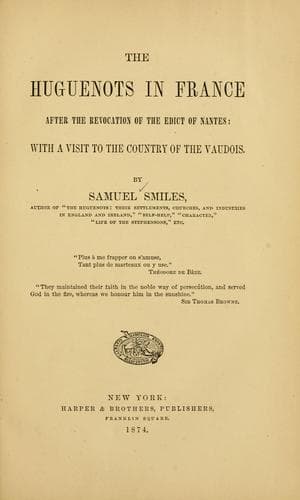
Dauphiné (France) -- Description and travel; Huguenots; Waldenses
This advice, if acted on, was virtually condemning the pastors to
death. Brousson was not a pastor. Would _he_ like to return to France
at the daily risk of the rack and the gibbet? The Protestant ministers
in exile defended themselves. Bénoît, then residing in Germany,
replied in a "History and Apology for the Retreat of the Pastors."
Another, who did not give his name, treated Brousson's censure as that
of a fanatic, who meddled with matters beyond his vocation. "You who
condemn the pastors for not returning to France at the risk of their
lives," said he, "_why do you not first return to France yourself?_"
Brousson was as brave as his words. He was not a pastor, but he might
return to the deserted flocks, and encourage and comfort them. He
could no longer be happy in his exile at Lausanne. He heard by night
the groans of the prisoners in the Tower of Constance, and the noise
of the chains borne by the galley slaves at Toulon and Marseilles. He
reproached himself as if it were a crime with the repose which he
enjoyed. Life became insupportable to him and he fell ill. His health
was even despaired of; but one day he suddenly rose up and said to his
wife, "I must set out; I will go to console, to relieve, to strengthen
my brethren, groaning under their oppressions."
His wife threw herself at his feet. "Thou wouldst go to certain
death," she said; "think of me and thy little children." She implored
him again and again to remain. He loved his wife and children, but he
thought a higher duty called him away from them. When his friends told
him that he would be taken prisoner and hung, he said, "When God
permits his servants to die for the Gospel, they preach louder from
the grave than they did during life." He remained unshaken. He would
go to the help of the oppressed with the love of a brother, the faith
of an apostle, and the courage of a martyr.
Brousson knew the danger of the office he was about to undertake.
There had, as we have seen, been numerous attempts made to gather the
Protestant people together, and to administer consolation to them by
public prayers and preaching. The persons who conducted these services
were not regular pastors, but only private members of their former
churches. Some of them were very young men, and they were nearly all
uneducated as regards clerical instruction. One of the most successful
was Isaac Vidal, a lame young man, a mechanic of Colognac, near St.
Hypolite, in the Cevennes. His self-imposed ministrations were
attended by large numbers of people. He preached for only six months
and then died--a natural death, for nearly all who followed him were
first tortured and then hung.
Public-domain text, read in full here on John Shaqi.
Reviews
Reviews
No reviews yet
Be the first to share your thoughts on this work.
Join the Discussion
Join the discussion
Sign in to leave a comment or review.
Sign InorCreate an account