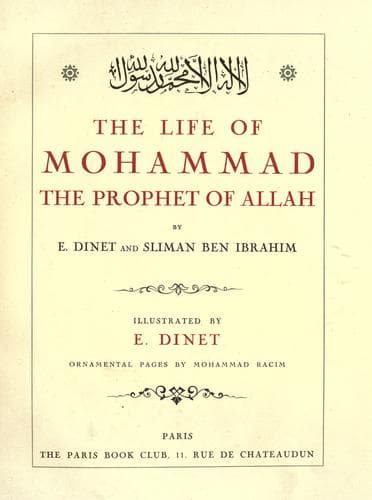
The Life of Mohammad, the Prophet of AllahDinet, Etienne
Religion
The Life of Mohammad, the Prophet of Allah
Dinet, Etienne
Muhammad, Prophet, -632
The wonderful charm of this Book, resembling no other masterpiece of
the literature of mankind, needs not to be explained to us Moslems,
because we consider it emanates from the words of Allah Himself, sent
down through the mouth of His Prophet. In this connection, we think it
will be interesting to quote the opinion of two Orientalists, justly
celebrated.
This is the conception of Savary, the first to translate the Qur'an
into French: "Mohammad was learned in the study of his language, the
richest and the most harmonious in the world, and which, by the
composition of its verses, permits thoughts as they soar to be
correctly described. By the harmony of its sounds, it imitates the
cries of animals, murmuring waters, thunder and the breeze. Mohammad,
I repeat, being past master of a language that so many poets have
embellished and which exists since the beginning of the world, took
great pains to add every charm of elocution to his precepts of
morality. Poets were greatly looked up to in Arabia. Labid ibn Rabyah,
an illustrious poet, nailed one of his poems on the door of the Temple
of Makkah. His reputation and the value of his works kept all
competitors away. None came forward to compete for the prize.... The
second chapter of the Qur'an--some writers say the 55th--was then
placed by the side of the poem. Labid, although a worshipper of graven
images, was seized with a fit of admiration after reading the first
verses and confessed himself vanquished."
He became a convert very soon after and one day, his admirers being
desirous of gathering together his complete works, questioned him on
this subject. 'I have no recollection of any of my poetry,' he
replied, 'for my entire memory hath been absorbed by the verses of the
Book of Revelation.'
We will now give the opinion of Stanley Lane Poole: "The style (of the
Surahs) is haughty in every part and full of passion. The words are
those of a man who tries with all his heart to convince his readers.
Even nowadays, they give an impression of the vehemence and fire with
which they were originally hurled forth at Mohammad's hearers
surrounding him. These are the broken utterances of a human heart
totally incapable of hypocrisy; the heart of a man who has exercised
extraordinary influence over mankind."
Public-domain text, read in full here on John Shaqi.
Reviews
Reviews
No reviews yet
Be the first to share your thoughts on this work.
Join the Discussion
Join the discussion
Sign in to leave a comment or review.
Sign InorCreate an account