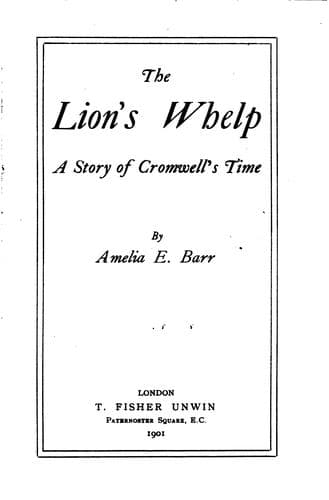
The Lion's Whelp: A Story of Cromwell's Time — John Shaqi
The Lion's Whelp: A Story of Cromwell's TimeBarr, Amelia E.
History
The Lion's Whelp: A Story of Cromwell's Time
Barr, Amelia E.
Great Britain -- History -- Stuarts, 1603-1714 -- Fiction
At Swaffham and de Wick this fateful feeling was aggravated by keen
personal interests. To Mrs. Swaffham and Jane the coming battle might
mean widowhood and orphanage; sons and brothers might be among those
appointed to die for Freedom’s sake. To de Wick it might mean the
extinction of the family, root and branch, the loss to the lonely Earl
and his daughter of the one love on which their future could build any
hope. They could not bear audibly to surmise these things, but they
feared them; and not even Jane had yet reached that far-seeing faith,
which, for a noble end, levels life and death. As the days went on they
ceased their usual employments; Jane went to the village, or even to Ely
in search of news, or perhaps half-way to de Wick met Matilda on the
same errand. Mutual fears drew them together; they talked and wept and
encouraged each other, and always parted with the one whispered
word—"_To-morrow._"
At length there came a day when the unnatural tension grew to its cruel
ripeness. The soft gray autumn morning was sensitive through every
pulse of Nature, and as the day wore on a strange still gloom hung far
and wide over the country. The very breath of calamity was in it.
Puritan and Royalist alike went to the open churches to pray; tradesmen
left their wares and stood talking and watching the highways; women
wandered about their homes weeping and praying inaudibly, or they let
their anxieties fret them like a lash. The next morning the west wind
blew the sorrow in the air, far-off to sea; but left an instantaneous,
penetrating sense of something being "all over." Whatever deed had been
done, England would soon ring with it.
On the third afternoon, there came rumours of a great Parliamentary
victory, rumours that Charles Stuart had been slain in battle,
suppositions and surmises innumerable and contradictory. Jane went as
quickly as possible to de Wick, for if indeed there had been a Royalist
defeat, Stephen de Wick might have reached home and life was hardly to
be borne, unless some certainty relieved the tension cutting like a
tight thong her heart and brain.
The neglect and desolation of de Wick Park had in it something unusual:
it was that strange air of sorrow, new and unaccepted, which insists on
recognition. It hurried Jane’s steps; she felt sure she was either
going to meet trouble or that trouble was following after her. When she
reached the house, there were two horses tied, and even two horses were
a strange sight, now, at that door where once there had been all day
long the noise and hurry of sportsmen, and of coming and going guests.
She entered the hall and saw a man in his stockinged feet softly
descending the stairs. She knew his name and his occupation, and her
heart stood still with fear. The next moment Delia came forward, and
Jane said,
"I am glad to see you back, Delia. Is Lady Matilda well? Is any one
ill? O Delia, what is the matter? Why are you crying? And why is
Jabez Clay here?"
Public-domain text, read in full here on John Shaqi.
Reviews
Reviews
No reviews yet
Be the first to share your thoughts on this work.
Join the Discussion
Join the discussion
Sign in to leave a comment or review.
Sign InorCreate an account