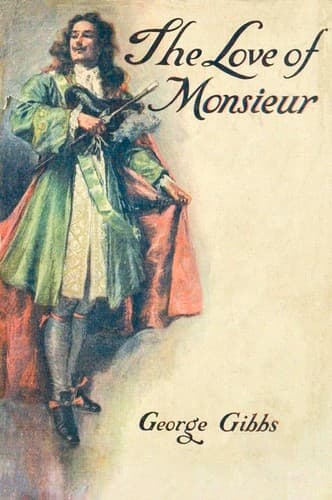
Adventure stories; French -- England -- Fiction; Great Britain -- History -- Charles II, 1660-1685 -- Fiction; Love stories
“Which way?” said Mornay.
“Straight ahead,” replied Cornbury. “To the river afterwards. Our
chances with a boat are best.”
They turned into a dark street, and Trice, who was slender and
nimble-footed, led the way into the darkness with the speed of a deer.
He wound in and out of alleys and narrow streets where the shadows
were deeper, closely followed by Mornay and Cornbury. The pace was so
rapid that Quinn was nearly spent. Seeing that if he were not heartened
he would be taken, Mornay slackened and came back beside him. As he
glanced around he saw that two men were approaching rapidly not a
hundred yards away.
“There’s nothing for it,” panted Cornbury. “If I had a pistol I could
wing the man in front.” Mornay drew his own from his pocket and handed
it to him. Cornbury leaned against a wall and carefully fired. With a
shout the man clapped his hand to his leg. He hobbled a few paces, and
then fell head over heels into the gutter. With singular discretion the
other man slackened his speed and stopped to await his fellows, who
were coming up in a body not far behind.
Tom Trice had disappeared, but the river was not far distant. Cornbury
saw the shimmer of it and said so to poor Quinn. This plucked up his
courage, and with a hand at either arm he managed to make so good a
progress that they had crossed the wide docks and tumbled into a boat
before the first of their pursuers had emerged from the darkness. Quinn
fell like a gasping fish under the thwarts, but Cornbury and Mornay
pulled at the oars with such vigor that before a single black figure
appeared upon the coping of the dock they had put fifty feet of water
between themselves and the shore. There was a splash of light--and
another--and the bullets spat viciously around them. But they kept on
pulling, and made the lee of a barge not far away in safety. When they
heard the constables clatter down into one of the boats, they took
off their doublets and pulled for their lives. The tide was running
out, and they shot the bridge like an arrow, but they could see the
black mass of the boat of their pursuers as it stole, like some huge
black bug, from the inky reflection into the gray of the open water.
There was a patch of light under the bows, and the frequent glimmer
of the wind-swept sky upon the oars was far too rapid and steady for
their comfort. A fellow stood up in the stern, giving the word for the
oarsmen, and, hard as the fugitives pulled, the boat gained steadily
upon them. Bill Quinn was useless, and, even had he been able to row,
there were only two pairs of oars. So they set him to loading the
pistols, while they cast their eyes over their shoulders in search of a
place of refuge. They knew if they made immediately for the shore they
would fall too probably into the hands of the watch, for the streets
here were wider and there were fewer places for concealment than in the
thickly settled part of the city which they had left. Their course was
Public-domain text, read in full here on John Shaqi.
Reviews
Reviews
No reviews yet
Be the first to share your thoughts on this work.
Join the Discussion
Join the discussion
Sign in to leave a comment or review.
Sign InorCreate an account