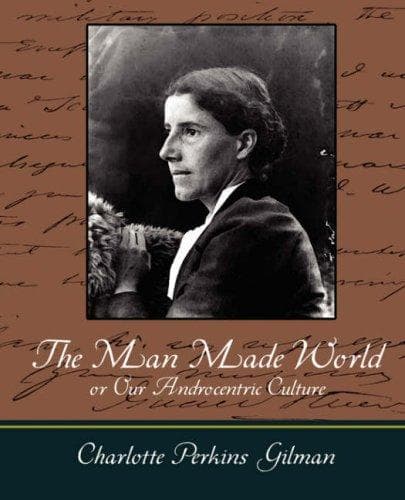
The Man-Made World; Or, Our Androcentric CultureGilman, Charlotte Perkins
General
The Man-Made World; Or, Our Androcentric Culture
Gilman, Charlotte Perkins
Women -- Social and moral questions; Women -- Social conditions
Then to-day rises a new cry against "women in education." Here is Mr.
Barrett Wendell, of Harvard, solemnly claiming that teaching women
weakens the intellect of the teacher, and every now and then bursts out
a frantic sputter of alarm over the "feminization" of our schools. It is
true that the majority of teachers are now women. It is true that they
do have an influence on growing children. It would even seem to be true
that that is largely what women are for.
But the male assumes his influence to be normal, human, and the female
influence as wholly a matter of sex; therefore, where women teach boys,
the boys become "effeminate"--a grievous fall. When men teach girls, do
the girls become -----? Here again we lack the analogue. Never has it
occurred to the androcentric mind to conceive of such a thing as being
too masculine. There is no such word! It is odd to notice that which
ever way the woman is placed, she is supposed to exert this degrading
influence; if the teacher, she effeminizes her pupils; if the pupil, she
effeminizes her teachers.
Now let us shake ourselves free, if only for a moment, from the
androcentric habit of mind.
As a matter of sex, the female is the more important. Her share of the
processes which sex distinction serves is by far the greater. To
be feminine--if one were nothing else, is a far more extensive and
dignified office than to be masculine--and nothing else.
But as a matter of humanity the male of our species is at present far
ahead of the female. By this superior humanness, his knowledge, his
skill, his experience, his organization and specialization, he makes and
manages the world. All this is human, not male. All this is as open
to the woman as the man by nature, but has been denied her during our
androcentric culture.
But even if, in a purely human process, such as education, she does
bring her special feminine characteristics to bear, what are they, and
what are the results?
We can see the masculine influence everywhere still dominant and
superior. There is the first spur, Desire, the base of the reward
system, the incentive of self-interest, the attitude which says, "Why
should I make an effort unless it will give me pleasure?" with its
concomitant laziness, unwillingness to work without payment. There is
the second spur, Combat, the competitive system, which sets one against
another, and finds pleasure not in learning, not exercising the mind,
but in getting ahead of one's fellows. Under these two wholly masculine
influences we have made the educational process a joy to the few who
successfully attain, and a weary effort, with failure and
contumely attached, to all the others. This may be a good method
in sex-competition, but is wholly out of place and mischievous in
education. Its prevalence shows the injurious masculization of this
noble social process.
What might we look for in a distinctly feminine influence? What are
these much-dreaded feminine characteristics?
Public-domain text, read in full here on John Shaqi.
Reviews
Reviews
No reviews yet
Be the first to share your thoughts on this work.
Join the Discussion
Join the discussion
Sign in to leave a comment or review.
Sign InorCreate an account