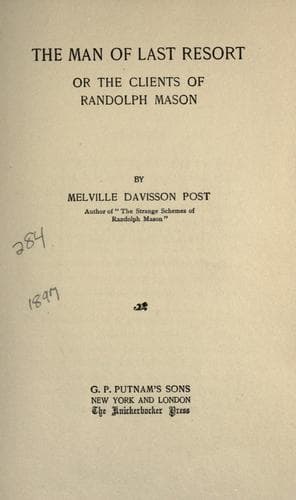
The Man of Last Resort; Or, The Clients of Randolph MasonPost, Melville Davisson
General
The Man of Last Resort; Or, The Clients of Randolph Mason
Post, Melville Davisson
American fiction -- 19th century; Detective and mystery stories, American; Legal stories, American
Carpenter was about to reply, when Lomax, noticing his excitement,
stepped in between Harrison and the elder attorney, and pointed out at
great length that this was all no doubt true, but that, under the law,
an indefinite religious organization, could not take a bequest; that
this was not generally known to those unfamiliar with legal business,
but that Mr. Dalton should have known that, in order to devise property
to a religious organization, it must be given to a board of trustees,
or to a certain person or persons, named in the will, for a specific
and accurately determined purpose; that this, Mr. Dalton should have
explained, and that his writing down the exact words of Mrs. Van Bartan
had defeated her intentions, and rendered this bequest void.
“But, sir,” put in the attorney Gouch, pompously, “the testatrix's
intention must control. I see no----”
“Come, come, my good man,” cried Carpenter, angrily, “this is what is
known in Virginia as a 'vague and indefinite charity.' Such bequests
have been held void for almost a century. Why Silas Hart attempted to
create such a devise as early as 1790, and John Marshall, Chief Justice
of the United States, held it void at law. Twenty years later.
Joseph Gallego attempted to bequeath a similar charity to the Roman
Catholic Church at Richmond, and Henry St. George Tucker, President of
the Supreme Court of Virginia, in a famous opinion, held that it must
fail, and from that time until the present the courts of this country
have been passing upon this common error of testators and their
incompetent advisers.”
Robert Dalton looked up anxiously. “In what cases?” he stammered.
“What cases!” almost shouted the elder counsellor, for he had now
lost his temper completely. “What cases, you bungler! Ask the veriest
pettyfogger; ask the commonest justice of the peace, but do not
catechise me.” And after having delivered himself of this venom, he
seized his hat and cane and stalked out of the house. He was greatly
enraged to think that a man of Dalton's learning, a member of a firm of
high standing, should make such a stupendous blunder.
Later in the day Robert Dalton came to the office and requested
Carpenter and Lomax to join him in his private room. His face showed
plainly the evidences of a great mental strain. When they were together
he closed the door, and, turning to them, said that he had examined the
question which they had raised, in regard to Mrs. Van Bartan's will, and
he was now satisfied that he had made a prodigious error in drafting
the instrument; that as his mistake would deprive a powerful church of
a vast estate, endless criticism of a most acrimonious character would
follow; that it was not just for any part of this criticism to fall
upon the shoulders of either Carpenter or Lomax, and, therefore, he
had determined to publicly withdraw from the firm. To this they made
scarcely a courteous objection, and Dalton accordingly withdrew,
publishing an announcement thereof in the daily papers.
Public-domain text, read in full here on John Shaqi.
Reviews
Reviews
No reviews yet
Be the first to share your thoughts on this work.
Join the Discussion
Join the discussion
Sign in to leave a comment or review.
Sign InorCreate an account