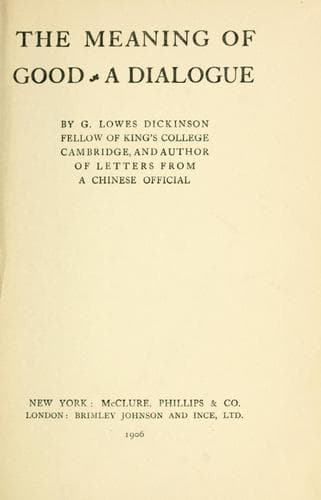
The Meaning of Good—A DialogueDickinson, G. Lowes (Goldsworthy Lowes)
Philosophy
The Meaning of Good—A Dialogue
Dickinson, G. Lowes (Goldsworthy Lowes)
Good and evil
"Well, if you will allow me to elaborate my metaphor, I conceive that
we have a kind of internal sense, like a rudimentary eye, whose
nature it is to be sensitive to Good, just as it is the nature of
the physical eye to be sensitive to light. But this eye of the soul,
being, as I said, rudimentary, does not as yet perceive Good with any
clearness or precision, but only in a faint imperfect way, catching
now one aspect of it, now another, but never resting content in any of
these, being driven on by the impulse to realize itself to ever surer
and finer discrimination, with the sense that it is learning its own
nature as it learns that of its object, and that it will never be
itself a true and perfect organ until it is confronted with the true
and perfect Good. And as by the physical eye we learn by degrees
to distinguish colours and forms, to separate and combine them,
and arrange them in definite groups, and then, going further, after
discerning in this way a world of physical things, proceed to fashion
for our delight a world of art, in that finer experience becoming
aware of our own finer self; so, by this eye of hers, does the soul,
by long and tentative effort, learn to distinguish and appraise the
Goods which Nature presents to her; and then, still unsatisfied,
proceed to shape for herself a new world, as it were, of moral art,
fashioning the relations of man to Nature and to his fellow-man under
the stress of her need to realize herself, ever creating and ever
destroying only to create anew, learning in the process her own
nature, yet aware that she has never learnt it, but passing on without
rest to that unimagined consummation wherein the impulse that urges
her on will be satisfied at last, and she will rest in the perfect
enjoyment of that which she knows to be Good, because in it she
has found not only her object but herself. Is not this a possible
conception?"
"I do not say," he replied, "that it is impossible; but I still feel a
difficulty."
"What is it?" I said, "for I am anxious not to shirk anything."
"Well," he said, "you will remember when Parry suggested that the
perception of Good might perhaps be an instinct, you objected that
instincts conflict one with another, and that we therefore require
another faculty to choose between them. Now it seems to me that
your own argument is open to the same objection. You postulate some
faculty--which perhaps you might as well call an instinct--and
this faculty, as I understand you, in the effort to realize itself,
proceeds to discriminate various objects as good. But, now, does this
same faculty also know that the Goods are good, and which is better
than which, and generally in what relations they stand to one another
and to the absolutely Good? Or do we not require here, too, another
faculty to make these judgments, and must not this faculty, as I
said at first, have previously achieved, by some method of its own, a
knowledge of Good, in order that it may judge between Goods?"
Public-domain text, read in full here on John Shaqi.
Reviews
Reviews
No reviews yet
Be the first to share your thoughts on this work.
Join the Discussion
Join the discussion
Sign in to leave a comment or review.
Sign InorCreate an account