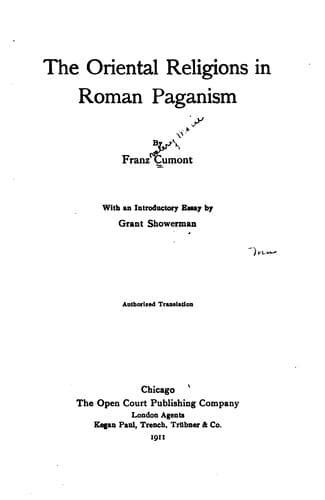
The Oriental Religions in Roman PaganismCumont, Franz
Religion
The Oriental Religions in Roman Paganism
Cumont, Franz
Paganism -- Rome; Religions; Rome -- Religion
When the Phrygians at a very early period came from Thrace and inserted
themselves like a wedge in the old Anatolian races, they adopted the vague
deities of their new country by identifying them with their own, after the
habit of pagan nations. Thus Attis became one with the Dionysus-Sabazius of
the conquerors, or at least assumed some of his characteristics. This
Thracian Dionysus was a god of vegetation. Foucart has thus admirably
pictured his savage nature: "Wooded summits, deep oak and pine forests,
ivy-clad caverns were at all times his favorite haunts. Mortals who were
anxious to know the powerful divinity ruling these solitudes had to observe
the life of his kingdom, {49} and to guess the god's nature from the
phenomena through which he manifested his power. Seeing the creeks descend
in noisy foaming cascades, or hearing the roaring of steers in the uplands
and the strange sounds of the wind-beaten forests, the Thracians thought
they heard the voice and the calls of the lord of that empire, and imagined
a god who was fond of extravagant leaps and of wild roaming over the wooded
mountains. This conception inspired their religion, for the surest way for
mortals to ingratiate themselves with a divinity was to imitate him, and as
far as possible to make their lives resemble his. For this reason the
Thracians endeavored to attain the divine delirium that transported their
Dionysus, and hoped to realize their purpose by following their invisible
yet ever-present lord in his chase over the mountains."[5]
In the Phrygian religion we find the same beliefs and rites, scarcely
modified at all, with the one difference that Attis, the god of vegetation,
was united to the goddess of the earth instead of living "in sullen
loneliness." When the tempest was beating the forests of the Berecyntus or
Ida, it was Cybele traveling about in her car drawn by roaring lions
mourning her lover's death. A crowd of worshipers followed her through
woods and thickets, mingling their shouts with the shrill sound of flutes,
with the dull beat of tambourines, with the rattling of castanets and the
dissonance of brass cymbals. Intoxicated with shouting and with uproar of
the instruments, excited by their impetuous advance, breathless and
panting, they surrendered to the raptures of a sacred enthusiasm. Catullus
has left us a dramatic description of this divine ecstasy.[6] {50}
Public-domain text, read in full here on John Shaqi.
Reviews
Reviews
No reviews yet
Be the first to share your thoughts on this work.
Join the Discussion
Join the discussion
Sign in to leave a comment or review.
Sign InorCreate an account