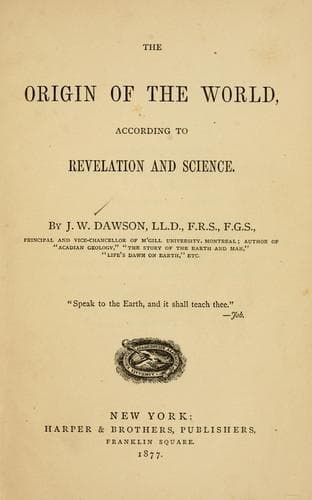
The Origin of the World According to Revelation and ScienceDawson, John William, Sir
Religion
The Origin of the World According to Revelation and Science
Dawson, John William, Sir
Bible and science; Religion and science
We shall find in our examination of the document itself that all the
instances of such accommodation which have been cited by writers on
this subject are as baseless as those above referred to. It is much to
be regretted that so many otherwise useful expositors have either
wanted that familiarity with the aspects of external nature by which
all the Hebrew writers are characterized, or have taken too little
pains to ascertain the actual meaning of the references to creation
which they find in the Bible. I may further remark that if such
instances of accommodation could be found in the later poetical books,
it would be extremely unfair to apply them as aids in the
interpretation of the plain, precise, and unadorned statements of the
first chapters of Genesis. There is, however, throughout even the
higher poetry of the Bible, a truthful representation and high
appreciation of nature for which we seek in vain in any other poetry,
and we may fairly trace this in part to the influence of the cosmogony
which appears in its first chapter. The Hebrew was thus taught to
recognize the unity of nature as the work of an Almighty Intelligence,
to regard all its operations as regulated by his unchanging law or
"decree," and to venerate it as a revelation of his supreme wisdom and
goodness. On this account he was likely to regard careful observation
and representation with as scrupulous attention as the modern
naturalist. Nor must we forget that the Old Testament literature has
descended to us through two dark ages--that of Greek and Roman
polytheism and of Middle Age barbarism--and that we must not confound
its tenets with those of either. The religious ideas of both these
ages were favorable to certain forms of literature and art, but
eminently unfavorable to the successful prosecution of the study of
nature. Hence we have a right to expect in the literature of the
golden age of primeval monotheism more affinity with the ideas of
modern science than in any intermediate time; and the truthful
delineation which the claims of the Bible to inspiration require might
have been, as already hinted, to a certain extent secured merely by
the reflex influence of its earlier statements, without the necessity
of our supposing that illustrations of this kind in the later books
came directly from the Spirit of God.
Public-domain text, read in full here on John Shaqi.
Reviews
Reviews
No reviews yet
Be the first to share your thoughts on this work.
Join the Discussion
Join the discussion
Sign in to leave a comment or review.
Sign InorCreate an account