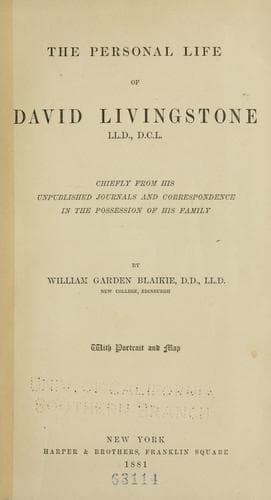
The Personal Life of David Livingstone: Chiefly from his Unpublished Journals and Correspondence in the Possession of His FamilyBlaikie, William Garden
Religion
The Personal Life of David Livingstone: Chiefly from his Unpublished Journals and Correspondence in the Possession of His Family
Blaikie, William Garden
Livingstone, David, 1813-1873
On all his fellow-students and acquaintances the simplicity, frankness,
and kindliness of Livingstone's character made a deep impression. Mr.
J.S. Cook, now of London, who spent three months with him at Ongar,
writes: "He was so kind and gentle in word and deed to all about him
that all loved him. He had always words of sympathy at command, and was
ready to perform acts of sympathy for those who were suffering." The
Rev. G.D. Watt, a brother Scotchman, who went as a missionary to India,
has a vivid remembrance of Livingstone's mode of discussion; he showed
great simplicity of view, along with a certain roughness or bluntness of
manner; great kindliness, and yet great persistence in holding to his
own ideas. But none of his friends seem to have had any foresight of
the eminence he was destined to attain. The Directors of the Society
did not even rank him among their ablest men. It is interesting to
contrast the opinion entertained of him then with that expressed by Sir
Bartle Frere, after much personal intercourse, many years afterward. "Of
his intellectual force and energy," wrote Sir Bartle, "he has given such
proof as few men could afford. Any five years of his life might in any
other occupation have established a character and raised for him a
fortune such as none but the most energetic of our race can
realize[18]."
[Footnote 18: _Good Words_, 1874, p. 285.]
But his early friends were not so much at fault. Livingstone was
somewhat slow of maturing. If we may say so, his intellect hung fire up
to this very time, and it was only during his last year in England that
he came to his intellectual manhood, and showed his real power. His very
handwriting shows the change; from being cramped and feeble it suddenly
becomes clear, firm, and upright, very neat, but quite the hand of a
vigorous, independent man.
Livingstone's prospects of getting to China had been damaged by the
Opium War; while it continued, no new appointments could be made, even
had the Directors wished to send him there. It was in these
circumstances that he came into contact with his countryman, Mr. (now
Dr.) Moffat, who was then in England, creating much interest in his
South African mission. The idea of his going to Africa became a settled
thing, and was soon carried into effect.
Public-domain text, read in full here on John Shaqi.
Reviews
Reviews
No reviews yet
Be the first to share your thoughts on this work.
Join the Discussion
Join the discussion
Sign in to leave a comment or review.
Sign InorCreate an account