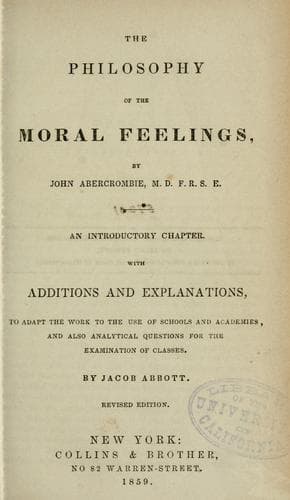
The Philosophy of the Moral FeelingsAbercrombie, John
Religion
The Philosophy of the Moral Feelings
Abercrombie, John
Ethics
Direct fallacy may consist in the alleged facts being absolutely false,
or in some of them being so,--in facts being wanting or kept out of view
which would give a different import to the whole statement,--or in some
of the facts being disguised, distorted, or coloured, so as to alter
materially the impression conveyed by them. But, besides such actual
fallacy, there are various methods by which a statement literally true
may be so related as to convey an erroneous impression. Facts may be
connected together in such a manner as to give the appearance of a
relation of cause and effect, when they are in truth entirely
unconnected;--or an event may be represented as common which has
occurred only in one or two instances. The character of an individual
may be assumed from a single act, which, if the truth were known, might
be seen to be opposed to his real disposition, and accounted for by the
circumstances in which he happened at the time to be placed. Events may
be connected together, which were entirely disjoined, and conclusions
deduced from this fictitious connexion, which are of course unfounded.
Several of these sources of fallacy may be illustrated by a ludicrous
example. A traveller from the continent has represented the venality of
the British House of Commons to be such, that, whenever the minister of
the Crown enters the house, there is a general cry for "places." It may
be true that a cry of "places" has gone round the house at certain
times, when business was about to commence, or to be resumed after an
interval,--meaning, of course, that members were to take their seats. It
is very probable, that, on some occasion, this may have occurred at the
moment when the minister entered,--so that the statement of the
traveller might, in point of fact, be strictly true. The erroneous
impression which he endeavours to convey by it, arises from three
sources of fallacy, which the anecdote will serve to illustrate,
namely,--the false meaning he gives to the word employed,--connecting it
with the entrance of the minister as cause and effect,--and representing
the connexion as uniform which happened to occur in that particular
instance. In the same manner it will appear, that a false impression may
be conveyed respecting the conduct of an individual,--by assigning
motives which are entirely imaginary,--by connecting things together
which have no relation,--by keeping out of view circumstances which
would afford an explanation or palliation of his conduct,--or by
attaching to his words a different meaning from that which he intended
to convey by them. The common saying, that there are two ways of telling
a story, does not therefore refer to what is strictly to be called
fabrication or falsehood; but to those distortions or colourings of
circumstances, which, however slight in themselves, have the effect of
essentially changing the impression made by the whole.
Public-domain text, read in full here on John Shaqi.
Reviews
Reviews
No reviews yet
Be the first to share your thoughts on this work.
Join the Discussion
Join the discussion
Sign in to leave a comment or review.
Sign InorCreate an account