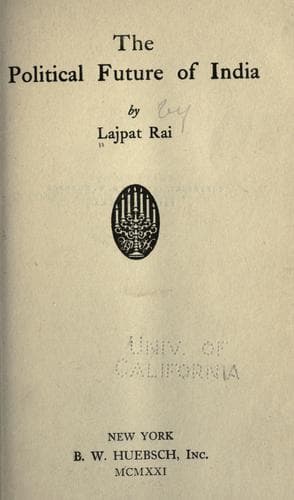
India -- History -- British occupation, 1765-1947; India -- Politics and government -- 1765-1947
The people of India are willing to be guided in their development
towards modern democracy by the people of Great Britain and they would
be grateful for their coöperation in this difficult task, but they must
be made to realize that the task is their own and that they should
undertake it in a spirit of courageous faith--faith in their destiny,
faith in their ability to achieve it, and faith in the friendship of the
great British nation. The test of all measures in relation to the
Government of India in future should be, not how far the people of
India can coöperate, how far they can be entrusted with responsibility,
but how far it is necessary _in their interests_ to control and check
them. The difference between the two points of view is fundamental and
important. Mr. Montagu and Lord Chelmsford have looked at the problem
from the former point of view; the Indian leaders want them to look at
it from the latter. They want the great British nation to recognise the
justice of India's claim to manage her own affairs, and to keep in their
hands in future only such control as is absolutely necessary (a) to
enable the Indian people to conduct their business efficiently and
successfully, (b) to make them fulfill their obligations to the great
Commonwealth of nations of which they hope soon to be a component part.
As long as British statesmen insist on looking at the problem from the
former point of view, they will make mistakes and raise a not entirely
unreasonable suspicion of their motives. The moment they adopt the other
point of view, they remove all grounds of distrust and create an
atmosphere of friendliness in which they can deal with the problem in a
spirit of mutual trust, absolute frankness and candid perspicacity.
There are many contentions of the British statesmen which the educated
Indians would gladly admit to be valid and necessary were they sure that
their admission would not be used against them by the power whom they
habitually regard as their adversary. There is much in this report which
could at once be struck out if both parties were actuated by feelings of
mutual trust and friendliness. It cannot be denied that many of the
proposed restrictions on the power of the popular assemblies and the
would-be Indian Administrators are the outcome of distrust. It is no
wonder then that the Indian leaders in their turn are not quite sure of
the face value of the many professions of good will that characterise
the scheme. It is for the removal of this distrust that we appeal as
earnestly as we can to the better mind of Great Britain.
Public-domain text, read in full here on John Shaqi.
Reviews
Reviews
No reviews yet
Be the first to share your thoughts on this work.
Join the Discussion
Join the discussion
Sign in to leave a comment or review.
Sign InorCreate an account