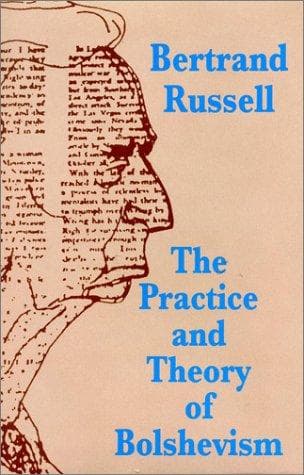
The Practice and Theory of BolshevismRussell, Bertrand
Religion
The Practice and Theory of Bolshevism
Russell, Bertrand
Communism -- Soviet Union -- History; Soviet Union -- Social conditions
Lack of fuel has been another very grave source of trouble. Before the
war coal came mostly from Poland and the Donetz Basin. Poland is lost
to Russia, and the Donetz Basin was in the hands of Denikin, who so
destroyed the mines before retreating that they are still not in
working order. The result is a practically complete absence of coal.
Oil, which is equally important in Russia, was also lacking until the
recent recovery of Baku. All that I saw on the Volga made me believe
that real efficiency has been shown in reorganizing the transport of
oil, and doubtless this will do something to revive industry. But the
oil used to be worked very largely by Englishmen, and English
machinery is much needed for refining it. In the meantime, Russia has
had to depend upon wood, which involves immense labour. Most of the
houses are not warmed in winter, so that people live in a temperature
below freezing-point. Another consequence of lack of fuel was the
bursting of water-pipes, so that people in Petrograd, for the most
part, have to go down to the Neva to fetch their water--a considerable
addition to the labour of an already overworked day.
I find it difficult to believe that, if greater efficiency had existed
in the Government, the food and fuel difficulties could not have been
considerably alleviated. In spite of the needs of the army, there are
still many horses in Russia; I saw troops of thousands of horses on
the Volga, which apparently belonged to Kalmuk tribes. By the help of
carts and sledges, it ought to be possible, without more labour than
is warranted by the importance of the problem, to bring food and
timber into Moscow and Petrograd. It must be remembered that both
cities are surrounded by forests, and Moscow at least is surrounded by
good agricultural land. The Government has devoted all its best
energies hitherto to the two tasks of war and propaganda, while
industry and the food problem have been left to a lesser degree of
energy and intelligence. It is no doubt probable that, if peace is
secured, the economic problems will receive more attention than
hitherto. But the Russian character seems less adapted to steady work
of an unexciting nature than to heroic efforts on great occasions; it
has immense passive endurance, but not much active tenacity. Whether,
with the menace of foreign invasion removed, enough day-by-day
detailed energy would exist for the reorganization of industry, is a
doubtful question, as to which only time can decide.
Public-domain text, read in full here on John Shaqi.
Reviews
Reviews
No reviews yet
Be the first to share your thoughts on this work.
Join the Discussion
Join the discussion
Sign in to leave a comment or review.
Sign InorCreate an account