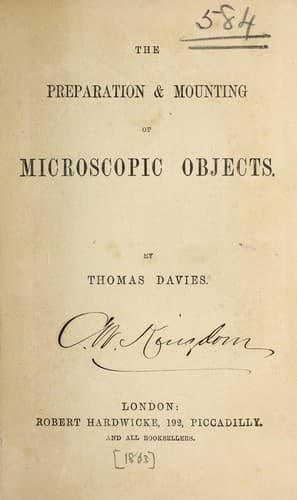
The preparation & mounting of microscopic objectsDavies, Thomas
Science
The preparation & mounting of microscopic objects
Davies, Thomas
Microscopy -- Technique
In the former chapter was noticed those insects or parts of them which
are usually mounted dry. When they are large and too opaque to admit of
the dry treatment, they must be preserved in Canada balsam or fluid.
The first of these may now be considered.
It may be here mentioned, that with these objects much heat must not be
employed, as it would in some instances give rise to a cloudiness, and
almost invariably injure them.
In killing the insect it is necessary not to rub or break any part of
it. This may be performed by placing it in a small box half filled with
fragments of fresh laurel leaves, by immersion in turpentine or strong
spirit, as also in solutions of various poisonous salts. After which
it may be preserved for sometime in turpentine or other preservative
liquid (Chapter IV.) until required. As an assistance to the student,
I believe that I can do no better than give him the plan pursued by my
friend Mr. Hepworth, whose specimens are in every way satisfactory;
but when his method is used, the insects must not have been placed in
turpentine for preservation:--
“After destroying the insects in chloroform or sulphuric ether
(methylated being cheaper), wash them thoroughly in a wide-necked
bottle, half-filled, with two or three waters; the delicate ones
requiring great care. Then immerse them in liquid potash (or Brandish’s
solution, which is stronger than the usual preparation), and let them
remain a longer or shorter time according to their texture. When ready
to remove, put one by one into a small saucer of clear water, and with
a camel-hair pencil in each hand press them flat to the bottom, holding
the head and thorax with the left-hand brush, and apply pressure with
the other from above, downwards, giving the brush a rolling motion,
which generally expels the contents of the abdomen from the thorax.
A minute roller of pith or cork might be used instead of the brush.
In larger objects, use the end of the finger to flatten them. Large
objects require more frequent washing, as it is desirable to remove the
potash thoroughly, or crystals are apt to form after mounting. Having
placed them on the slides with thin glass covers, tied down with
thread,[C] dry and immerse them in rectified spirits of turpentine;
place the vessel under the receiver of an air-pump, and keep it
exhausted until the turpentine has taken the place of the air-bubbles:
they are then ready for the application of the balsam. Larger objects
may often with advantage be transferred to a clean slide, as during the
drying there is considerable contraction, and an outline often remains
beyond the margin showing this. When closely corked they may remain in
the spirits two or three months. As you take them from the bottle, wipe
as much turpentine off as possible before removing the thread, and when
untied carefully wipe again, placing the finger on one end of the cover
whilst you wipe the other, and vice versâ. By this means you remove
Public-domain text, read in full here on John Shaqi.
Reviews
Reviews
No reviews yet
Be the first to share your thoughts on this work.
Join the Discussion
Join the discussion
Sign in to leave a comment or review.
Sign InorCreate an account