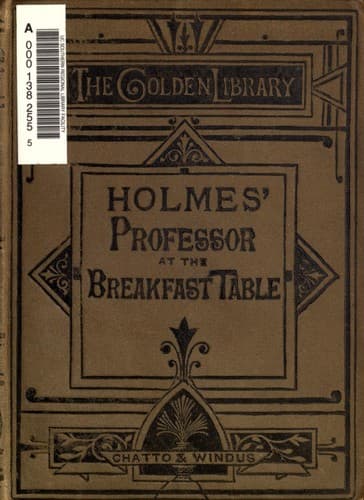
The Professor at the Breakfast-TableHolmes, Oliver Wendell
General
The Professor at the Breakfast-Table
Holmes, Oliver Wendell
American fiction -- 19th century; Conversation -- Fiction; Poetry
--We think Baltimore is a pretty civilized kind of a village,--said the
young Marylander, good-naturedly.--But I suppose you can't forgive it
for always keeping a little ahead of Boston in point of numbers,--tell
the truth now. Are we not the centre of something?
Ah, indeed, to be sure you are. You are the gastronomic metropolis
of the Union. Why don't you put a canvas-back-duck on the top of the
Washington column? Why don't you get that lady off from Battle Monument
and plant a terrapin in her place? Why will you ask for other glories
when you have soft crabs? No, Sir,--you live too well to think as hard
as we do in Boston. Logic comes to us with the salt-fish of Cape Ann;
rhetoric is born of the beans of Beverly; but you--if you open your
mouths to speak, Nature stops them with a fat oyster, or offers a slice
of the breast of your divine bird, and silences all your aspirations.
And what of Philadelphia?--said the Marylander.
Oh, Philadelphia?--Waterworks,--killed by the Croton and Cochituate;
--Ben Franklin,--borrowed from Boston;--David Rittenhouse,--made an
orrery;--Benjamin Rush,--made a medical system;--both interesting to
antiquarians;--great Red-river raft of medical students,--spontaneous
generation of professors to match;--more widely known through the
Moyamensing hose-company, and the Wistar parties;-for geological section
of social strata, go to The Club.--Good place to live in,--first-rate
market,--tip-top peaches.--What do we know about Philadelphia, except
that the engine-companies are always shooting each other?
And what do you say to New York?--asked the Koh-i-noor.
A great city, Sir,--replied the Little Gentleman,--a very opulent,
splendid city. A point of transit of much that is remarkable, and of
permanence for much that is respectable. A great money-centre. San
Francisco with the mines above-ground,--and some of 'em under the
sidewalks. I have seen next to nothing grandiose, out of New York,
in all our cities. It makes 'em all look paltry and petty. Has many
elements of civilization. May stop where Venice did, though, for
aught we know.--The order of its development is just this:--Wealth;
architecture; upholstery; painting; sculpture. Printing, as a mechanical
art,--just as Nicholas Jepson and the Aldi, who were scholars too, made
Venice renowned for it. Journalism, which is the accident of business
and crowded populations, in great perfection. Venice got as far as
Titian and Paul Veronese and Tintoretto,--great colorists, mark you,
magnificent on the flesh-and-blood side of Art,--but look over to
Florence and see who lie in Santa Crocea, and ask out of whose loins
Dante sprung!
Oh, yes, to be sure, Venice built her Ducal Palace, and her Church of
St. Mark, and her Casa d' Or, and the rest of her golden houses; and
Venice had great pictures and good music; and Venice had a Golden Book,
in which all the large tax-payers had their names written;--but all that
did not make Venice the brain of Italy.
Public-domain text, read in full here on John Shaqi.
Reviews
Reviews
No reviews yet
Be the first to share your thoughts on this work.
Join the Discussion
Join the discussion
Sign in to leave a comment or review.
Sign InorCreate an account