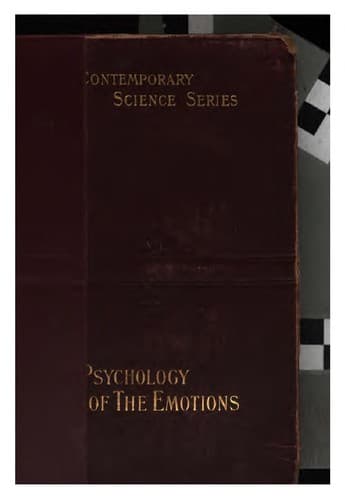
The Psychology of the EmotionsRibot, Th. (Théodule)
Science
The Psychology of the Emotions
Ribot, Th. (Théodule)
Emotions
There is another possible hypothesis, quite different from the
others, which I should be willing to accept, but which cannot be
presented as more than a theory. It would consist in attributing the
genesis of pain to _chemical modifications_ in the tissues and
nerves, especially the production of local or general toxins in the
organism. Pain would thus be one of the forms of auto-intoxication.
Oppenheimer alone seems to me to have worked in this direction.[28]
In his opinion, as regards the origin of pain, “the real cause, in
any sensorial or other organ, resides in a change in the tissues,
especially a chemical change, by which either the products of
destruction rise above the normal average, or else modifications
result from the presence of a foreign body in the organism.” The
connection between the peripheral tissues and the centres would be
by the vaso-motor nerves (constrictor or dilator). The tissues would
be the terminal organs of pain, the vaso-motors the paths of
conduction. In organs which only undergo slight changes when active
(tendons, ligaments, bones, etc.) conscious sensibility is almost
absent. “Pain is not, as many believe, the highest degree of
sensation produced in the organs of special sense; it is the most
intense sensation produced in the vaso-motor nerves under the
influence of violent stimulation.”
-----
Footnote 28:
_Schmerz. und Temperaturempfindung_, Berlin, 1893.
-----
This hypothesis will perhaps be justified by the future. I shall
return to it when studying the emotions. We shall then see that
these are accompanied by deep and well-established chemical
modifications in the organism.
Physical pain is a large subject, which, as may be seen, has not
been neglected of late, and concerning which there is still much to
say. It is not possible, however, to deal further with it here,
since it only occupies a limited area in the psychology of the
emotions.
CHAPTER II.
MORAL PAIN.
_Identity of all the forms of pain—Evolution of moral pain: (1) the
pure result of memory; (2) connected with representations;
positive form, negative form; (3) connected with concepts—Its
external study; physical signs—Therapeutics—Conclusions—A
typical case of hypochondriasis._
Public-domain text, read in full here on John Shaqi.
Reviews
Reviews
No reviews yet
Be the first to share your thoughts on this work.
Join the Discussion
Join the discussion
Sign in to leave a comment or review.
Sign InorCreate an account