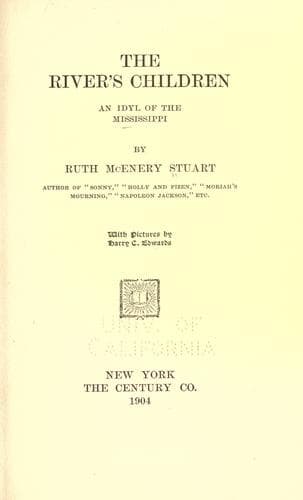
The River's Children: An Idyl of the MississippiStuart, Ruth McEnery
General
The River's Children: An Idyl of the Mississippi
Stuart, Ruth McEnery
African Americans -- Fiction; Conduct of life -- Fiction; Mississippi River -- Fiction; Poverty -- Fiction
"Oh, yes," she replied to a question; "I suppose I do remember a good
deal, considering how very young I was, and yet I often wonder that I do
not remember more, as it was all so unusual;" and then she added,
laughing: "I seem to forget that no event could surprise a child _in her
first experiences of life_. Yet I remember trivial things, as, for
instance, the losing of a hat. I clearly recall our watching my hat on
one occasion when it blew into the river, _and was never recovered_!
Think of the tragedy of it! I can see it now, tossing like a little
boat, as it floated away.
"And the funny little cabin I remember--I know I do, for there were
things which papa never saw, on the inside, in what he calls my
'boudoir,' the white cabin, which I shall never forget. When anything is
kept ever in mind by constant description, it is hard to know how much
one really remembers. You know, papa spent only one night there and his
thoughts were turned backward, so that he naturally kept only vague
impressions of the place.
"Yes, he has made a sketch of it from memory, and I am sorry. Why? Oh,
because I was sure at first that it was not correct, and now it has come
to stand to me in place of the true picture, which has faded. It is a
way with pictures if we let them over-ride us. Why, my grandmother in
Boston has a friend who had his wife's portrait painted after she was
lost at sea. He spent all the money he had to have it done by a 'best
artist who had made a hasty sketch of her in life,' and when it came
home he did not recognize it--really thought a mistake had been made.
Then, seeing that it _was she_ as authoritatively pictured, and that he
had paid his all to get it, he bethought him to study it, hoping some
day to find her in it. And so he did, gradually.
"He had it hung over his smoking-table, and every evening he scrutinized
it until its insistence conquered. For a whole year he lived in the
companionship of an absent wife as seen in an artist's mood (this last
sentence is a direct quotation from my Boston grandmama, who is fond of
the story). And--well, 'what happened?' Why, _this_: One day the woman
came home. People 'lost at sea' occasionally do, you know. And would you
believe it? Her widower--I mean to say her husband--refused to receive
her. _He did not know her!_ He simply pointed to the painting and shook
his head. And if she hadn't been a person of resolution and
resource,--descended from the _Mayflower_,--why, she would have had to
go away. But she had her trunk brought in and quietly paid the
expressman and took off her bonnet--_and stayed_. But it was an absurdly
long time before her husband was wholly convinced that he was not the
victim of an adventuress. And she says that even now he sometimes looks
at her in a way she does not like.
"So, you see, we cannot always believe our own eyes, which are so easily
tricked.
Public-domain text, read in full here on John Shaqi.
Reviews
Reviews
No reviews yet
Be the first to share your thoughts on this work.
Join the Discussion
Join the discussion
Sign in to leave a comment or review.
Sign InorCreate an account