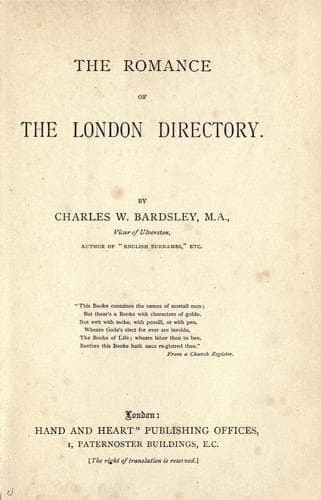
The Romance of the London DirectoryBardsley, Charles Wareing Endell
History
The Romance of the London Directory
Bardsley, Charles Wareing Endell
Names, English -- England -- London; Names, Personal -- England -- London
If it were necessary, we could easily show how the same thing has
happened to the vocabularies of the two countries that has befallen the
two nomenclatures. We smile when a Yankee says, “I guess,” “I
calculate,” and “I reckon;” but when we read in the Epistle of St. Paul
the sentence “_I reckon_ that the sufferings of this present time are not
worthy to be compared with the glory which shall be revealed in us,” do
we always reflect, as we might do, that our translators and revisers of
1611 were simply putting into the mouth of the apostle a phrase which was
then colloquial English, but now survives, in all its familiarity, only
in the United States, whither the Puritan Fathers had carried it? This
comparison we might easily extend, but it is not our subject.
As for American baptismal nomenclature in general, it is all but entirely
Biblical. The only book the refugee took with him was his English Bible.
His piety was fed from its pages, his life was likened to its histories,
his surroundings had the same cast of primeval simplicity; he discovered
a resemblance between his own new life and that of the patriarchs, and it
pleased him to stereotype the resemblance by the adoption of their names.
From out that Book alone he named his offspring, and thus to this
day,—such is the power of tradition,—“Brother Jonathan” and “Uncle Sam”
are but representatives of a class of names which well-nigh engrosses
every other. A single instance will suffice to show how this great mass
of Biblical nomenclature arose. Charles Chauncy died in New England,
1671. He emigrated from Hertfordshire, where the family had been settled
for centuries. His children were Isaac, Ichabod, Sarah, Barnabas,
Elnathan, Nathaniel, and Israel. All these grew up and settled in New
England.
It has been well said, that were it not for our English Bible the two
languages of the United States and England would slowly but surely
separate themselves into two distinct dialects, possibly tongues.
Certainly it is to that book which Wycliffe,—whom we commemorated in
1877,—wrote into English, we owe the fact that in no respect is there a
closer bond and deeper sympathy betwixt England and America than in that
which concerns the nomenclature of the two countries. In what respect
they differ I have shown. While _we_ have dropped some names that marked
eccentricity, and restored some of the older and more pagan cognomens
from the oblivion that seemed so certainly to await them, _they_ have
clung tenaciously to that more quaint and large class of names of
Scriptural origin, which their forefathers of Puritan stock bore with
them across the ocean in days when America was as yet a portion of the
British dominions.
Public-domain text, read in full here on John Shaqi.
Reviews
Reviews
No reviews yet
Be the first to share your thoughts on this work.
Join the Discussion
Join the discussion
Sign in to leave a comment or review.
Sign InorCreate an account