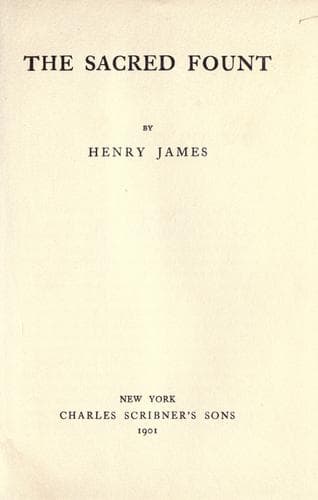
Man-woman relationships -- England -- Fiction; Married people -- England -- Fiction; Psychological fiction
"Oh, I _do_ so wonder!" she replied with the refined but exaggerated
glee that is a frequent form in high companies and light colloquies. I
_did_ help her--it was admirable to feel it. She liked my imposing on
her no more complex a proposition. She liked my putting the thing to her
so much better than she could have put it to me. But she immediately
afterwards looked away as if--now that we _had_ put it, and it didn't
matter which of us best--we had nothing more to do with it. She gave me
a hint of drops and inconsequences that might indeed have opened up
abysses, and all the while she smiled and smiled. Yet whatever she did
or failed of, as I even then observed to myself, how she remained
lovely! One's pleasure in that helped one somehow not to break down on
one's own side--since breaking down was in question--for commiseration.
I didn't know what she might have hours of for the man--whoever he
was--to whom her sacrifice had been made; but I doubted if for any other
person she had ever been so beautiful as she was for me at these
moments. To have kept her so, to have made her more so--how might that
result of their relation not in fact have shone as a blinding light into
the eyes of her lover? What would he have been bound to make out in her
after all but her passion and her beauty? Wasn't it enough for such
wonders as these to fill his consciousness? If they didn't fill
mine--even though occupying so large a place in it--was that not only
because I had not the direct benefit of them as the other party to the
prodigy had it? They filled mine too, for that matter, just at this
juncture, long enough for me to describe myself as rendered subject by
them to a temporary loss of my thread. What _could_ pass muster with her
as an account of my reason for evoking the blighted identity of our
friend? There came constantly into her aspect, I should say, the
strangest alternatives, as I can only most conveniently call them, of
presence and absence--something like intermissions of intensity,
cessations and resumptions of life. They were like the slow flickers of
a troubled flame, breathed upon and then left, burning up and burning
down. She had really burnt down--I mean so far as her sense of things
went--while I stood there.
Public-domain text, read in full here on John Shaqi.
Reviews
Reviews
No reviews yet
Be the first to share your thoughts on this work.
Join the Discussion
Join the discussion
Sign in to leave a comment or review.
Sign InorCreate an account