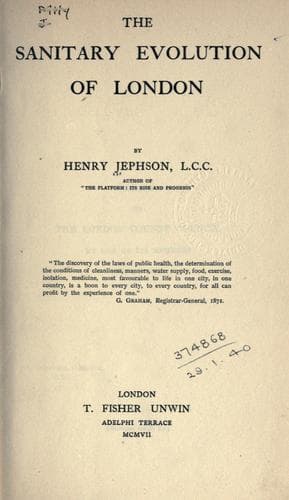
The Sanitary Evolution of LondonJephson, Henry (Henry Lorenzo)
History
The Sanitary Evolution of London
Jephson, Henry (Henry Lorenzo)
Public health -- England -- London
Though three Acts were thus passed, they formed but separate parts of
one general plan of reform.
Some little detail must be gone into as regards the system of local
government thus initiated.
For government in purely local matters--in each of the twenty-three
largest parishes, definite Vestries, as distinguished from parishioners
meeting in open Vestry, were constituted, the members thereof being
elected by the householders of the respective parishes rated to the
relief of the poor. The total number of members on any Vestry was not
to exceed one hundred and twenty, and each year one-third of them were
to retire, and an election to be held to fill their places.
And as there were many parishes so small that to have constituted
them separate local governing authorities would have perpetuated all
the evils of small areas of local government, these small parishes
were grouped together into "districts" of a fairly large size, for
each of which--some fourteen in number--there was to be a governing
body entitled "The Board of Works for the ---- District," the members
thereof being elected, not directly by the electors, but by the smaller
Vestries constituting the District.
These new local governing bodies were thus representative bodies,
the Vestries elected directly by the ratepayers, the District Boards
indirectly elected; but both were constituted "the sanitary authority"
for their respective areas, both were charged with the administration
of local affairs, and so the term "Vestry" and the "District Board" may
be taken as synonymous.
The central body which was constituted for dealing with matters
affecting London as a whole was named "The Metropolitan Board of
Works."
It was not directly elected by the ratepayers of London, but was
elected by the aforesaid local authorities and by the "City."
It consisted of forty-five members. Three were elected by "the
Mayor, aldermen, and commons of the City of London in common council
assembled."
Each of the six largest Vestries elected two of their members to it;
the other Vestries one each, and the District Boards of Works elected
the remainder.
It was thus representative of the whole of London--City and Metropolis
included. Each year one-third of the members were to retire, and
one-third to be elected in their place.
This central Board was charged with many important duties affecting
London as a whole. Foremost amongst them was the first essential of any
sanitary well-being--the improvement of the sewerage and drainage of
London.
This new body superseded the Commissioners of Sewers, and was specially
charged with the task of designing and carrying out "a system of
sewerage which should prevent all or any part of the sewage within
the metropolis from passing into the river Thames in or near the
metropolis: and also make all such other sewers and works as they
may from time to time think necessary for the effectual sewerage and
drainage of the metropolis."
Public-domain text, read in full here on John Shaqi.
Reviews
Reviews
No reviews yet
Be the first to share your thoughts on this work.
Join the Discussion
Join the discussion
Sign in to leave a comment or review.
Sign InorCreate an account