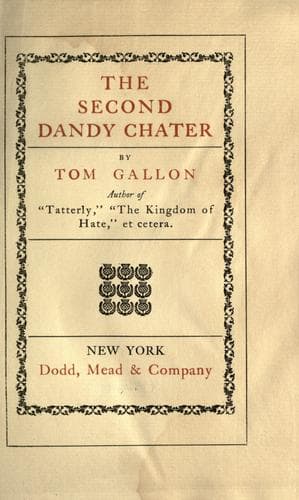
England -- Fiction; Impostors and imposture -- Fiction; Love stories; Mystery fiction
“I think we shall probably have some news to-night,” replied the second
man. “Our people have got hold of an idea that the police have spotted
their man, and may get hold of him within the next few hours. I hear
that Tokely has the case in hand.”
“Ah—smart man, Tokely,” said the other nodding. “I wonder if that
swell who was spoken about had anything to do with it?”
“I dare say,” replied his friend, coolly. “If so, it’ll make rare good
copy—won’t it? Trusting village maiden—young Squire—and all the
other details. By Jove—won’t our people lick it up!”
Philip Chater, sick at heart, turned away, and tried to busy himself in
the paper he had bought. But the more he tried to read, and to fix his
mind on the page before him, the more hopeless became the tangle into
which the words seemed to form themselves. He thought of himself—a
fugitive; of his brother, fished out of the river, and perhaps by this
time identified. Philip Chater had but to think, for an instant, of the
contents of his own pockets at that moment, to realise the desperate
position in which he stood.
He had the dead man’s watch and chain—his cheque book and other
papers; he had upon him also, a large number of bank-notes, which he
knew must have been stolen, and part of which he had paid away to cover
up a forgery which he was also supposed to have committed. More than
all, he was venturing now into the very heart of the enemy’s country,
in the hope to stop a robbery, with which he was also connected—and at
the house of the woman he loved. It is small wonder that he saw, in all
this, a resistless tide, which must sooner or later sweep him to
destruction.
Arriving at the small station for which he had taken his ticket, he
alighted with the two newspaper men, and saw them get into a vehicle
which had evidently been ordered for them. Not wishing to ask any more
questions than were absolutely necessary, he watched this carriage, as
it drove away, and followed the road it took. Glancing at the watch he
carried, by the light of the last lamp he passed, he saw that it was
nearly eight o’clock; and he had, so far as he could judge, nearly
eleven miles to go before reaching Bamberton. But his purpose was a
strong one, and the night was fine; he set out to walk the distance,
knowing that he dared not ask for a lift from any passing cart, lest he
should be recognised.
At one or two points on his journey, where sign-posts were too
illegible to be read, or the night too dark to see them clearly, he was
compelled to wait—fuming and impatient—until such time as a
slow-footed, slow-voiced countryman should come in sight. At such times
Philip Chater pulled his hat down as far as possible over his face, and
kept in the shadow. But he got through each interview safely, until
within a mile or two of the village—when taking a wrong turning and
losing his bearings hopelessly, he was obliged to wait again, in the
hope of some one passing him.
Public-domain text, read in full here on John Shaqi.
Reviews
Reviews
No reviews yet
Be the first to share your thoughts on this work.
Join the Discussion
Join the discussion
Sign in to leave a comment or review.
Sign InorCreate an account