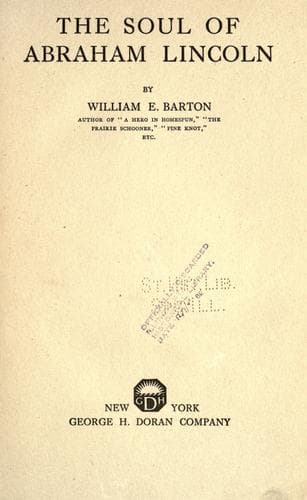
The Soul of Abraham LincolnBarton, William E. (William Eleazar)
Religion
The Soul of Abraham Lincoln
Barton, William E. (William Eleazar)
Lincoln, Abraham, 1809-1865 -- Religion; Presidents -- United States -- Biography
Of Lincoln's theological opinions, especially those which he cherished
while at New Salem, and which Herndon believed he did not materially
change, Herndon says:
"Inasmuch as he was often a candidate for public office Mr. Lincoln
said as little as possible about his religious opinions, especially
if he failed to coincide with the orthodox world. In illustration of
his religious code, I once heard him say that it was like that of an
old man named Glenn, in Indiana, whom he heard speak at a religious
meeting, and who said, 'When I do good, I feel good; when I do bad,
I feel bad; and that's my religion.' In 1834, while still living in
New Salem, and before he became a lawyer, he was surrounded by a
class of people exceedingly liberal in matters of religion. Volney's
_Ruins_ and Paine's _Age of Reason_ passed from hand to hand, and
furnished food for the evening's discussion in the tavern and village
store. Lincoln read both these books, and assimilated them into his
own being. He prepared an extended essay--called by many, a book--in
which he made an argument against Christianity, striving to prove that
the Bible was not inspired, and therefore not God's revelation, and
that Jesus Christ was not the Son of God. The manuscript containing
these audacious and comprehensive propositions he intended to have
published or given a wide circulation in some other way. He carried
it to the store, where it was read and freely discussed. His friend
and employer, Samuel Hill, was among the listeners, and seriously
questioning the propriety of a promising young man like Lincoln
fathering such unpopular notions, he snatched the manuscript from his
hands, and thrust it into the stove. The book went up in flames, and
Mr. Lincoln's political future was secure. But his infidelity and his
skeptical views were not diminished."--HERNDON, III, 439-440.
Public-domain text, read in full here on John Shaqi.
Reviews
Reviews
No reviews yet
Be the first to share your thoughts on this work.
Join the Discussion
Join the discussion
Sign in to leave a comment or review.
Sign InorCreate an account