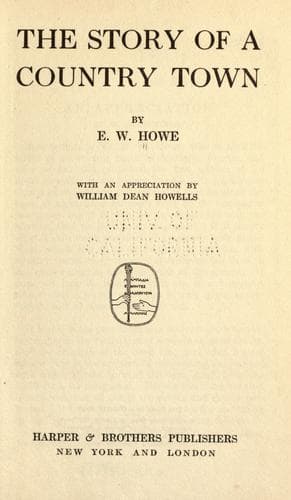
The Story of a Country TownHowe, E. W. (Edgar Watson)
General
The Story of a Country Town
Howe, E. W. (Edgar Watson)
Frontier and pioneer life -- Kansas -- Fiction
He came to our house originally, I believe, on some sort of business,
and, becoming acquainted, happened in at long intervals afterwards, but
I never knew that he went anywhere else. We all admired him, for he was
a man to make himself welcome anywhere, and he sat quietly among us
when he came (which was always at night, as though for private reasons
he did not walk out during the day), and listened to what was being
said. My father had the greatest respect for him, and was often uneasy
under his steady gaze, as if he felt that Damon Barker was not a
Fairview man, and had knowledge and opinions of his own. They frequently
discussed all sorts of questions (or rather my father discussed them in
Barker’s presence, who only made short answers indicating that he was
familiar with the subject in hand), and I was forced to the belief that,
had he seen fit, he could have readily torn to pieces many of the
arguments advanced. His knowledge of religious topics was extensive, but
he patronized the subject as he would patronize a child, dismissing it
with a polite word as though it was of no consequence; and we wondered
that a man who understood the subject so well could be indifferent, for
it was well known that he was not religious. My father often threatened
to “speak” to him about it, but he never did, either fearing that Barker
might be able to defend his position, or respecting his disposition to
avoid the subject.
Although he was courteous and well-bred, lifting his hat and bowing to
my mother in the most courtly manner when he came and went, it was never
remarked to his discredit, although a man of his manners had never been
seen by us before. Had he been the least awkward in his politeness, I am
sure we should have laughed at him, and regarded him as a fop, for we
watched him narrowly; but his adieus and greetings were so appropriate,
natural, and easy, that we received them as a matter of course, and
accepted them as evidences not merely of different but of better
breeding than we were accustomed to. During one of his visits to the
house he invited Jo and me to the mill, asking it as a favor, and thus
it came about that occasionally we went to see him on Saturday
afternoons, returning the next day. Indeed, we were rather encouraged to
go to Barker’s, my father believing that familiarity with such a courtly
gentleman would do us no harm, if no good, and he was not greatly
displeased if we did not return until late Sunday evening, although he
always inquired what we found so entertaining at his house, and on our
replying, he found no objection to it.
Public-domain text, read in full here on John Shaqi.
Reviews
Reviews
No reviews yet
Be the first to share your thoughts on this work.
Join the Discussion
Join the discussion
Sign in to leave a comment or review.
Sign InorCreate an account