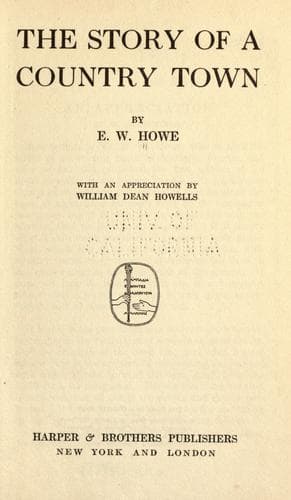
The Story of a Country TownHowe, E. W. (Edgar Watson)
General
The Story of a Country Town
Howe, E. W. (Edgar Watson)
Frontier and pioneer life -- Kansas -- Fiction
Before he knew Jo and me he had no friends--he told me this himself
early in our acquaintance--but we amused him, and he became our
companion in everything we did while at the house or mill, instructing
and benefiting us in a hundred ways. When I say he became our companion
in everything we did, I mean no more than that he was always with us,
looking on good-naturedly when we played the games at cards he taught
us, accompanying us when we walked through the woods or rowed on the
river, and giving suggestions and help in everything. He said but little
at any time, except in answer to our questions, and I think his
principal enjoyment in our companionship was to listen quietly to what
we had stored up to tell him on our different visits.
He was regarded as hard and exacting by those with whom he had business
dealings--he dealt in nothing else--but was always kind and liberal with
Jo and me, giving us money frequently, and presents when he could get
them. If we were in the mill with him, the entrance of a customer would
harden his features until we were afraid of him, and we went away until
the customer had gone when he soon became himself again, so that we grew
to be afraid of him except when we were alone.
In Barker’s room was a great box-stove in which we made wonderful fires
in winter, and the fire in it seemed never to go out; so that I have
thought in summer that, if the ashes were stirred, live coals could be
found at the bottom. Around this we always sat with him during the
winter nights (and we had opportunity to visit him oftener in winter
than at any other time, for during that season we had the least to do),
and did whatever Barker thought would best amuse us. Sometimes he gave
us suppers, prepared by his own hands from cans and bottles stored away
in other chests we had not yet examined; at other times he told us the
story of one of the brass pistols, or of the strange wearing-apparel we
had seen, holding the article in his hand to illustrate; or if we found
something belonging to a ship, he told us of the sea, of storms, of
strange countries, and of wrecks.
In all the stories of robbers and pirates that he told us--and there
were many of that kind because we preferred them--I always thought of
him as one of the participants, and was pleased when the one I had
picked out for Barker freed the captive maiden, flinging back his
companions who would murder her, with the declaration that he would have
their lives if they persisted, thereupon conducting her within sight of
her home, and, having first bidden her a gallant adieu, galloped away.
These recitals had much of dashing romance in them, and his robberies
were committed generally from motives of daring rather than gain. It was
always the mean and stingy misers who were robbed, and if a beautiful
maiden was captured at sea she was always taken to her friends, unless
she freely consented to marry the pirate captain, which was sometimes
the case.
Public-domain text, read in full here on John Shaqi.
Reviews
Reviews
No reviews yet
Be the first to share your thoughts on this work.
Join the Discussion
Join the discussion
Sign in to leave a comment or review.
Sign InorCreate an account