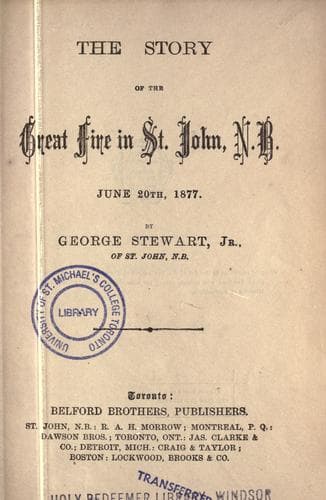
The Story of the Great Fire in St. John, N.B., June 20th, 1877Stewart, George
History
The Story of the Great Fire in St. John, N.B., June 20th, 1877
Stewart, George
Saint John (N.B.) -- Fire, 1877
The Rev. A. McL. Stavely is the senior Presbyterian clergyman of St.
John. He came to the city in the ship _Eagle_, August 3rd, 1841, having
been ordained minister at Kilbrought, Ireland, June 12th, of the same
year. On the 7th of August, 1841, he preached his first sermon in the
first Reformed Presbyterian Church which was then in the building in
Lower Cove, opposite the Public Schools, known as the Wheeler property.
He was the first minister of that denomination who came to the city, and
has continued ever since in charge of this body. In 1850, the Lower Cove
Church was sold, and has been since used for manufacturing purposes.
The church on the corner of Princess and Sydney Streets, and which was
burned, was erected in 1850. The house adjoining and which was
originally intended as a parsonage, was purchased by Mr. Stavely, as his
private house, and he has been living in it for twenty-seven years. In
1870, at a cost of $2,000, the basement of the church was excavated, and
a fine new hall for general purposes was made. By the fire Mr. Stavely
loses heavily, and his library, the accumulation of many years, was
destroyed.
Probably, the greatest wreck of the day was the destruction of the
costly and splendid new Victoria School--a building which presented a
massive front, and occupied a commanding position on the corner of Duke
and Sydney Streets. This was the edifice which many who lived up the
street as far as Carmarthen Street firmly believed would act as a
barrier to the flames, and keep off the fire from their houses. Some so
implicitly believed this that until the high walls fairly bent over, not
an effort was made to remove even a picture from the rooms. O, said the
householders on Upper Duke street, that immense pile will never burn; we
are safe enough. But the proud edifice where a thousand children
received daily a free education, did burn, and the sight though
terrible, was one of the most impressive of the day. Now there was
hurrying and packing in three score houses at once, and loud cries to
teamsters and shrieks to servants and porters rent the air. Those, who
talked the loudest before the school was in ashes, exhibited the
greatest despair when they saw what they believed up to this moment to
be their surest safeguard, encircled in the fury of the flames, going
down before their eyes. First the wood-work around the sashes gave way,
and lights shot from half a hundred windows, and the crash of glass as
it was hurled to the pavement showed that the great fire had abated not
a jot. The hot slates on the roof came down the giddy height in scores,
and one man pinned to the earth by a falling slate was carried away
insensible of pain but with a two-inch wound upon his scalp. The flames
crackled for a while and then the dull, heavy sound of weighty bodies
falling inside sent a shudder through the waiting, watching crowd below.
The woodwork snapped and sang in the blaze, and the great stones on the
Public-domain text, read in full here on John Shaqi.
Reviews
Reviews
No reviews yet
Be the first to share your thoughts on this work.
Join the Discussion
Join the discussion
Sign in to leave a comment or review.
Sign InorCreate an account