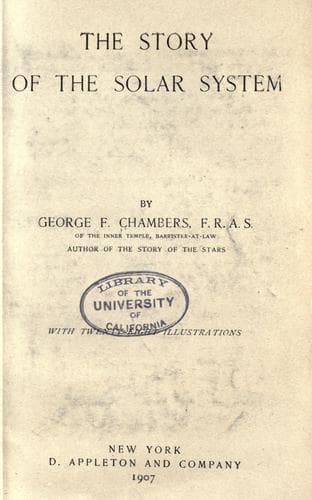
The Story of the Solar SystemChambers, George F. (George Frederick)
Science
The Story of the Solar System
Chambers, George F. (George Frederick)
Solar system
As an optical phenomenon the twinkling, or to use the more scientific
phrase, the scintillation, of the stars is a matter which has been
strangely ignored by physicists. Indeed, the only investigators who seem
to have dealt with it in any sort of detail are two Italians, Secchi and
Respighi, Dufour, a Frenchman, Montigny, a Belgian, and the Rev. E.
Ledger, an Englishman. Secchi has truly remarked that the twinkling of
the stars is one of the most beautiful of the minor phenomena of the
heavens. Light, sometimes bright, sometimes feeble, sometimes white,
sometimes red, darts about in intermittent gleams, like the sparkling
flashes of a well-cut diamond, and works upon the feelings of even the
most stolid spectator. The theory of twinkling is still surrounded by
many difficulties. One thing, however, is certain—it has nothing to do
with recurrent changes in the intrinsic light or physical condition of
the star itself, but arises during the passage of its rays through our
atmosphere; it depends, therefore, in some way or other on the varying
conditions of the atmosphere. On the summit of high mountains, according
to the observations of all careful observers (notably Tacchini, who
studied the subject on Mount Etna), the light of the stars is steady,
like that of the planets; and it is so likewise during the hours of calm
which often precede terrestrial storms. The vibrations are usually more
frequent near the horizon, and diminish with the elevation of the star
above the horizon; in other words, with the lessening of the thickness
of the atmospheric strata which the rays of light have to traverse.
Nevertheless, during windy weather, and specially with northerly wind,
it may be noticed that the stars twinkle high up above the horizon, and
even as far as the zenith. From these and other similar considerations
we are justified in drawing the conclusion that twinkling largely
depends on the condition and movements of the atmosphere.
Public-domain text, read in full here on John Shaqi.
Reviews
Reviews
No reviews yet
Be the first to share your thoughts on this work.
Join the Discussion
Join the discussion
Sign in to leave a comment or review.
Sign InorCreate an account