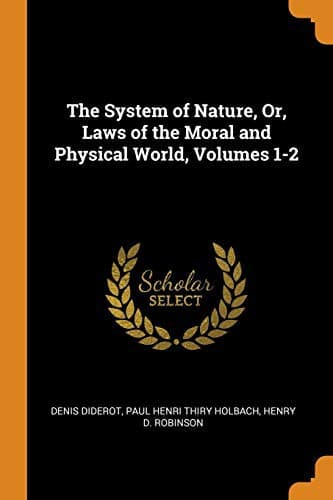
The System of Nature, or, the Laws of the Moral and Physical World. Volume 2Holbach, Paul Henri Thiry, baron d'
Religion
The System of Nature, or, the Laws of the Moral and Physical World. Volume 2
Holbach, Paul Henri Thiry, baron d'
Materialism; Philosophy and religion; Psychology
surprised if the superstitious man was in a state of continual alarm:
if he experienced trances--if his mind was ever in the most tormenting
dread; the idea of his gods recalled to him unceasingly, that of a
pitiless tyrant who sported with the miseries of his subjects; who,
without being conscious of their own wrong, might at each moment incur
his displeasure: he could not avoid feeling that although they had
formed the universe entirely for man, yet justice did not regulate the
actions of these powerful beings, or rather those of the priests; but he
also believed that their elevated rank placed them infinitely above the
human species, that therefore they might afflict him at their pleasure.
It is then for want of considering good and evil as equally necessary;
it is for want of attributing them to their true causes, that man has
created to himself fictitious powers, malicious divinities, respecting
whom it is found so difficult to undeceive him. Nevertheless, in
contemplating nature, he would have been able to have perceived, that
_physical evil_ is a necessary consequence of the peculiar properties of
some beings; he would have acknowledged that plague, contagion,
disease, are due to physical causes under particular circumstances;
to combinations, which, although extremely natural, are fatal to his
species; he would have sought--in the bosom of nature herself the
remedies suitable to diminish these evils, or to have caused the
cessation of those effects under which he suffered: he would have
seen in like manner that _moral evil_ was the necessary consequence
of defective institutions; that it was not to the Divinity, but to the
injustice of his fellows he ought to ascribe those wars, that
poverty, those famines, those reverses of fortune, those multitudinous
calamities, those vices, those crimes, under which he so frequently
groans. Thus to rid himself of these evils he would not have uselessly
extended his trembling hands towards shadows incapable of relieving him;
towards beings who were not the authors of his sorrows; he would have
sought remedies for these misfortunes in a more rational
administration of justice--in more equitable laws--in more I reasonable
institutions--in a greater degree of benevolence towards his fellow
man--in a more punctual performance of his own duties.
Public-domain text, read in full here on John Shaqi.
Reviews
Reviews
No reviews yet
Be the first to share your thoughts on this work.
Join the Discussion
Join the discussion
Sign in to leave a comment or review.
Sign InorCreate an account