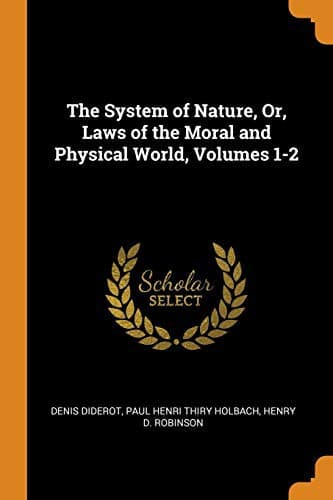
The System of Nature, or, the Laws of the Moral and Physical World. Volume 2Holbach, Paul Henri Thiry, baron d'
Religion
The System of Nature, or, the Laws of the Moral and Physical World. Volume 2
Holbach, Paul Henri Thiry, baron d'
Materialism; Philosophy and religion; Psychology
Every thing that has been said, proves pretty clearly, that, in despite
of all his efforts, man has never been able to prevent himself from
drawing together from his own peculiar nature, the qualities he has
assigned to the Being who governs the universe. The contradictions
necessarily resulting from the incompatible assemblage of these human
qualities, which cannot become suitable to the same subject, seeing
that the existence of one destroys the existence of the other, have
been shewn:--the theologians themselves have felt the insurmountable
difficulties which their divinities presented to reason: they were
so substantive, that as they felt the impossibility of withdrawing
themselves out of the dilemma, they endeavoured to prevent man
from reasoning, by throwing his mind into confusion--by continually
augmenting the perplexity of those ideas, already so discordant, which
they offered him of the gods. By these means they enveloped them in
mystery, covered them with dense clouds, rendered them inaccessible to
mankind: thus they themselves became the interpreters, the masters of
explaining, according either to their fancy or their interest, the ways
of those enigmatical beings they made him adore. For this purpose they
exaggerated them more and more--neither time nor space, nor the
entire of nature could contain their immensity--every thing became an
impenetrable mystery. Although man has originally borrowed from himself
the traits, the colours, the primitive lineaments of which he composed
his gods; although he has made them jealous, powerful, vindictive
monarchs, yet his theology, by force of dreaming, entirely lost sight
of human nature. In order to render his divinities still more different
from their creatures, it assigned them, over and above the usual
qualities of man, properties so marvellous, so uncommon, so far removed
from every thing of which his mind could form a conception, that he lost
sight of them himself. From thence he persuaded himself these qualities
were divine, because he could no longer comprehend them; he believed
them worthy of his gods, because no man could figure to himself any one
distinct idea of them. Thus theology obtained the point of persuading
man he must believe that which he could not conceive; that he must
receive with submission improbable systems; that he must adopt, with
pious deference, conjectures contrary to his reason; that this reason
itself was the most agreeable sacrifice he could make on the altars of
his gods, who were unwilling he should use the gift they had bestowed
upon him. In short, it had made mortals implicitly believe that they
were not formed to comprehend the thing of all others the most important
to themselves. Thus it is evident that superstition founded its basis
upon the absurd principle that man is obliged to accredit firmly that
which he is in the most complete impossibility of comprehending. On
the other hand, man persuaded himself that the gigantic, the truly
Public-domain text, read in full here on John Shaqi.
Reviews
Reviews
No reviews yet
Be the first to share your thoughts on this work.
Join the Discussion
Join the discussion
Sign in to leave a comment or review.
Sign InorCreate an account