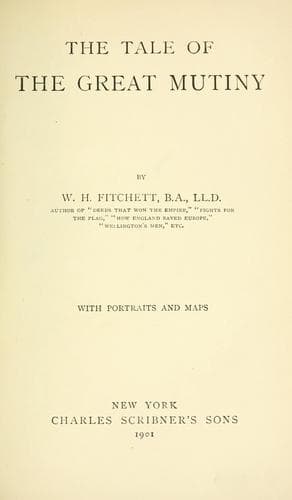
The Tale of the Great MutinyFitchett, W. H. (William Henry)
History
The Tale of the Great Mutiny
Fitchett, W. H. (William Henry)
India -- History -- Sepoy Rebellion, 1857-1858
In these words Sir George Trevelyan sums up the famous struggle round
the low mud-walls of Wheeler’s entrenchments at Cawnpore more than forty
years ago; a struggle in which Saxon courage and Hindu cruelty were
exhibited in their highest measure, and which must always form one of
the most heartbreaking and yet kindling traditions of the British race.
Volumes have been written about Cawnpore, but Trevelyan’s book remains
its one adequate literary record. The writer has a faculty for resonant,
not to say rhythmic prose, which recalls the style of his more famous
uncle, Macaulay, and in his “Cawnpore” his picturesque sentences are
flushed with a sympathy which gives them a more than literary grace.
Cawnpore at the time of the Mutiny was a great city, famous for its
workers in leather, standing on the banks of the sacred Ganges, 270 miles
S.E. from Delhi, and about 700 miles from Calcutta. It was a military
station of great importance. Its vast magazine was stored with warlike
material of every sort. It was the seat of civil administration for a
rich district. But the characteristic British policy, which allows the
Empire to expand indefinitely, without any corresponding expansion of
the army which acts as its police and defence, left this great military
station practically in the hands of the Sepoys alone. The British force
at Cawnpore, in May 1857, consisted of sixty men of the 84th, sixty-five
Madras Fusileers, fewer than sixty artillerymen, and a group of invalids
belonging to the 32nd. The Sepoy force consisted of three strong infantry
regiments and the 2nd Native Cavalry—a regiment of very evil fame.
Here, then, were all the elements of a great tragedy—a rich treasury and
a huge arsenal, lying practically undefended; a strong force of Sepoys,
bitter with mutiny; a turbulent city and crowded cantonments festering
with crime; and only a handful of British soldiers to maintain the
British flag! Had the British consisted merely of fighting men, though
they counted only 300 bayonets against four regiments of splendidly
trained Sepoys, and a hostile population of 60,000, their case would not
have been desperate. But the little British garrison had under its guard
a great company of women and children and sick folk—civilian households,
the wives and families of the 32nd, and many more. For every fighting man
who levelled his musket over Wheeler’s entrenchments during the siege,
there were at least two non-combatants—women, or little children, or
invalids. A company so helpless and so great could not march; it could
not attack; it could only stand within its poor screen of mud-walls and,
with the stubborn and quenchless courage natural to its blood, fight till
it perished.
Public-domain text, read in full here on John Shaqi.
Reviews
Reviews
No reviews yet
Be the first to share your thoughts on this work.
Join the Discussion
Join the discussion
Sign in to leave a comment or review.
Sign InorCreate an account