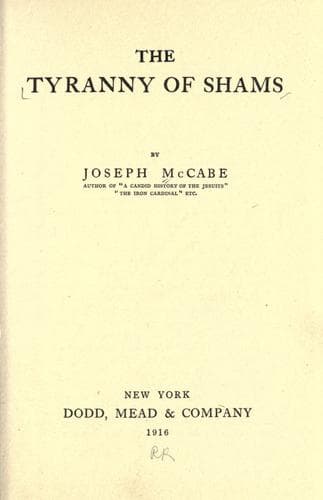
Great Britain -- Social conditions; Moral conditions; Social problems
The modern age, with its inconvenient questions and its bold speech,
arrives. Commerce develops, and the palace and cathedral disappear, in
the forest of soaring buildings. When the roofs of the new commerce
and the new commoner rise to a level with the roof of the palace or
the cathedral, when men are no longer overshadowed by the old powers,
the imagination is released. The divine right of kings goes in a fury
of revolutionary flame: kings must henceforth rule by human right and
answer at a human tribunal, which is more exacting and alert than the
old tribunal. Yet the power of the dead tradition is amazing. In England
men still bow reverently when the king addresses them as "my subjects"
and talks of "my empire": still crown every entertainment, spiritual
or gastronomic, with fervent aspirations which would lead an
ill-informed spectator to imagine that they regarded the king's health
as mystically connected with the health of the nation: still describe
bishops and the heads of families which have been sufficiently long
idle and wealthy as their "lords."
These archæological survivals are, no doubt, innocuous, if
irritating. The more serious feature is that they help to make so many
people insensible of the miserable compromises we endure in our
reorganised State. They are part of that superabundant ash which
clogs and dulls the fire of the nation's life. The nineteenth
century, rightly and inevitably, adopted a democratic scheme of public
administration. It was seen that, if the king were not so close a
friend of the Almighty as had been supposed, there was no visible
reason why the destinies of the nation should be entrusted to his
judgment: which was, as a rule, not humanly impressive. Luckily,
certain nations had won the right to do a good deal of talking before
the king came to a decision, or the right to hold Parliaments, and
Europe generally adopted this model. The Parliament House now towered
upward in the city, and it did the real business of directing the
nation's affairs. The king became a kind of grand seal for the
measures enacted by Parliament. Some nations, the number of which is
increasing, regarded the seal as a costly and avoidable luxury, and
abolished it: some kept the king, with all his stately language and
pretty robes and sparkling jewellery, and abolished the "lords":
some kept the king and the lords, but deprived them of real power. The
English nation, which is famous for its common-sense, its audacity,
and its ability, belongs to the last group. It invented that
remarkable phrase, "self-government": which ingeniously preserves
the fiction that someone has a right to govern other people, yet
conciliates the modern spirit by intimating that the people really
govern their governors.
Public-domain text, read in full here on John Shaqi.
Reviews
Reviews
No reviews yet
Be the first to share your thoughts on this work.
Join the Discussion
Join the discussion
Sign in to leave a comment or review.
Sign InorCreate an account