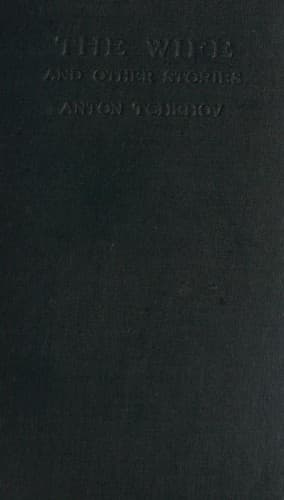
The Wife, and Other StoriesChekhov, Anton Pavlovich
General
The Wife, and Other Stories
Chekhov, Anton Pavlovich
Chekhov, Anton Pavlovich, 1860-1904 -- Translations into English; Russia -- Social life and customs -- Fiction; Short stories
On a still moonlight night in July Olga Ivanovna was standing on the
deck of a Volga steamer and looking alternately at the water and at the
picturesque banks. Beside her was standing Ryabovsky, telling her the
black shadows on the water were not shadows, but a dream, that it would
be sweet to sink into forgetfulness, to die, to become a memory in the
sight of that enchanted water with the fantastic glimmer, in sight of
the fathomless sky and the mournful, dreamy shores that told of the
vanity of our life and of the existence of something higher, blessed,
and eternal. The past was vulgar and uninteresting, the future was
trivial, and that marvellous night, unique in a lifetime, would soon be
over, would blend with eternity; then, why live?
And Olga Ivanovna listened alternately to Ryabovsky’s voice and the
silence of the night, and thought of her being immortal and never dying.
The turquoise colour of the water, such as she had never seen before,
the sky, the river-banks, the black shadows, and the unaccountable joy
that flooded her soul, all told her that she would make a great artist,
and that somewhere in the distance, in the infinite space beyond the
moonlight, success, glory, the love of the people, lay awaiting her....
When she gazed steadily without blinking into the distance, she seemed
to see crowds of people, lights, triumphant strains of music, cries of
enthusiasm, she herself in a white dress, and flowers showered upon
her from all sides. She thought, too, that beside her, leaning with his
elbows on the rail of the steamer, there was standing a real great
man, a genius, one of God’s elect.... All that he had created up to the
present was fine, new, and extraordinary, but what he would create in
time, when with maturity his rare talent reached its full development,
would be astounding, immeasurably sublime; and that could be seen by his
face, by his manner of expressing himself and his attitude to nature.
He talked of shadows, of the tones of evening, of the moonlight, in
a special way, in a language of his own, so that one could not help
feeling the fascination of his power over nature. He was very handsome,
original, and his life, free, independent, aloof from all common cares,
was like the life of a bird.
“It’s growing cooler,” said Olga Ivanovna, and she gave a shudder.
Ryabovsky wrapped her in his cloak, and said mournfully:
“I feel that I am in your power; I am a slave. Why are you so enchanting
today?”
He kept staring intently at her, and his eyes were terrible. And she was
afraid to look at him.
“I love you madly,” he whispered, breathing on her cheek. “Say one word
to me and I will not go on living; I will give up art...” he muttered
in violent emotion. “Love me, love....”
“Don’t talk like that,” said Olga Ivanovna, covering her eyes. “It’s
dreadful! How about Dymov?”
Public-domain text, read in full here on John Shaqi.
Reviews
Reviews
No reviews yet
Be the first to share your thoughts on this work.
Join the Discussion
Join the discussion
Sign in to leave a comment or review.
Sign InorCreate an account