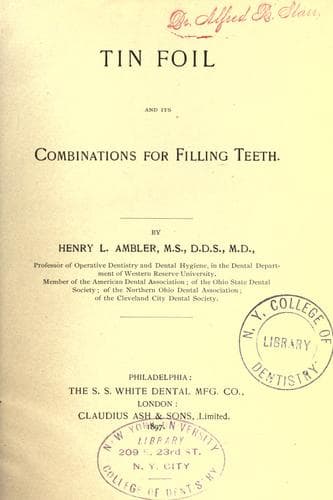
Tin Foil and Its Combinations for Filling TeethAmbler, Henry Lovejoy
Science
Tin Foil and Its Combinations for Filling Teeth
Ambler, Henry Lovejoy
Dentistry
Cylinders were used which were a little longer than the depth of the
cavity, introduced with wedge-shaped pluggers around the walls, each one
being closely adapted to the margin; then another row was added, which
was forced firmly against the preceding, continuing this process until
the cavity was full. The wedge, having a smooth end and sides, is forced
into the center so as to drive the tin toward the sides of the cavity,
being careful not to split the tooth; the opening is then filled with a
cylinder. Now force a smaller-sized wedge into the center of the last
cylinder, and into the opening introduce another cylinder, proceeding in
this manner until the filling is solid. Then condense the ends of the
cylinders, trim, and burnish. For the same operation more recent
pluggers are wedge-shaped, with sharp, deep serrations. In these cases
the filling is retained by the general form of the cavity and wedging
within a certain limit, and not by cohesion of the different parts. For
a time tin cylinders were prepared and put on sale at the dental depots.
As far as we are aware, the first tin foil made use of in operative
technics was by Dr. F. S. Whitslar, who removed a disk of German silver
from an ivory knife-handle in 1845, then used hand pressure to fill the
cavity with tin. In the college course of operative technics tin foil
can be used, almost to the exclusion of gold foil, to demonstrate the
manipulation of both cohesive and non-cohesive gold. Shavings scraped
from a bar of tin are also useful in operative technics; they are more
cohesive than foil.
Public-domain text, read in full here on John Shaqi.
Reviews
Reviews
No reviews yet
Be the first to share your thoughts on this work.
Join the Discussion
Join the discussion
Sign in to leave a comment or review.
Sign InorCreate an account