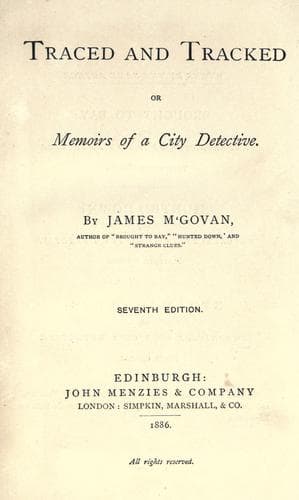
Traced and Tracked; Or, Memoirs of a City Detective — John Shaqi
Traced and Tracked; Or, Memoirs of a City DetectiveM'Govan, James
General
Traced and Tracked; Or, Memoirs of a City Detective
M'Govan, James
Detective and mystery stories; Edinburgh (Scotland) -- Fiction
“Spotted!” cried Shorty, with an oath; and the rest of the journey
across the roofs to the hatch where The Fin awaited him was performed
in “the best time on record.” As a matter of fact the policeman had
neither seen Shorty nor made a motion in his direction, but Shorty
hurriedly explained the position to his chum, and after a brief
council of war they rid themselves of the plunder, dropped through
the inner hatch, and escaped downstairs, by the backdoor, across some
greens. They took separate routes, certain that they were being hotly
pursued, and got into hiding at once.
A few hours later the robbery was discovered and reported at the
Office. As in few cases of the kind, we were able to take down a
pretty full and accurate list of the articles stolen, including,
of course, the silver ring of the servant and the heavy gold chain
already noticed.
With this list, and the knowledge that so many of the articles were
easily identifiable, I had little doubt but we should soon lay hands
on either the thief or part of the plunder. I was mistaken. None of
my “bairns” showed an overflow of money; not the slightest sign of
“a great success” appeared anywhere; and none of those had up on
suspicion had heard of the deed. Some of them strongly asserted that
the whole thing was a sham, and really done by an amateur—one of the
servants or some of her followers. One of the boldest to assert this
was Shorty himself, whom I had invited to accompany me to the Office,
and who had followed me with an alacrity which caused my hopes to
sink at once to zero. As for The Fin, he was not a man of words, and
only scowled, and told us to hurry with our investigations, as he
did not care for the Lock-up, and wanted back to his den. We did not
hurry particularly, knowing that both were safer and more harmless
under lock and key than at liberty, but events hurried for us in a
manner anticipated neither by them nor us. While the two worthies
were still in our keeping, I chanced one day to call upon an honest
jeweller who dealt in the precious metals, and was shown by him a
piece of a heavy gold chain which he had that day bought from a lad
whose name and address was in his book. The piece was about eighteen
inches long, and at one end showed a clean cut, as if it had been
either clipped through with strong shears or cut with a chisel, half
of the severed link being still attached to the chain. It was fine 22
carat gold, and so uncommon-looking that the jeweller had questioned
the seller closely as to how it came into his possession.
“He said that it had belonged to his mother, and they had had it for
years locked away, but, seeing that it was of no use, they thought of
having it made into a brooch,” continued the jeweller. “He was just a
working lad,—not at all like a thief,—so I believed him, and paid him
for it according to weight and quality.”
“Why did he not have it made into a brooch?” I sceptically inquired.
Public-domain text, read in full here on John Shaqi.
Reviews
Reviews
No reviews yet
Be the first to share your thoughts on this work.
Join the Discussion
Join the discussion
Sign in to leave a comment or review.
Sign InorCreate an account