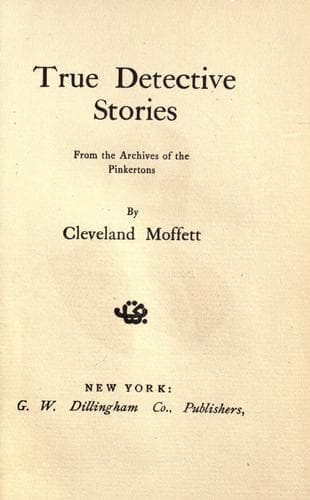
True Detective Stories from the Archives of the PinkertonsMoffett, Cleveland
History
True Detective Stories from the Archives of the Pinkertons
Moffett, Cleveland
Crime -- United States; Criminals -- United States; Detective and mystery stories, American
Burke winced perceptibly when he saw conductor Ashmore and Mr. Shaw,
and went fairly wild when confronted by Mr. Pollock. Requisition
papers were obtained from the governor of the State of Iowa on the
governor of Colorado, and the Colorado offense being a minor one,
Burke was turned over to Assistant Superintendent Fraser and another
detective, to be taken to Logan, Harrison County, Iowa. Before leaving
Leadville, Mr. Fraser was confidentially warned by the sheriff of the
county that he could not be too careful of his prisoner; for that
Burke, through a friend of the sheriff, had made a proposition to the
latter to pay him a thousand dollars if he would secretly furnish him
with a revolver when he left the jail, his design being, with this
revolver, to either "hold up" or kill the two detectives who had him
in custody and make his escape from the train.
On trial at Logan, Iowa, the man was easily convicted, and was
sentenced to imprisonment for a term of seventeen years.
The Rock Island Express
[Illustration: ROBERT A. PINKERTON]
I
The through express on the Rock Island road left Chicago at 10:45 P.
M., on March 12, 1886, with twenty-two thousand dollars in fifty- and
one-hundred-dollar bills in the keeping of Kellogg Nichols, an
old-time messenger of the United States Express Company. This sum had
been sent by a Chicago bank to be delivered at the principal bank in
Davenport, Iowa. In addition to the usual passenger-coaches, the train
drew two express-cars: the first, for express only, just behind the
engine; and, following this, one for express and baggage. These cars
had end doors, which offer the best opportunity to train robbers.
Messenger Nichols was in the first car, and was duly at his work when
the train stopped at Joliet, a town about forty miles west of Chicago.
But at the next stop, which was made at Morris, Harry Schwartz, a
brakeman, came running from Nichols's car, crying, "The messenger is
dead."
The messenger's lifeless body was found lying on the floor of the car.
The head had been crushed by some heavy weapon, and there was a
pistol-wound in the right shoulder. Apparently he had been overcome
only after a hard fight. His face was set with fierce determination.
His fists were clenched, and the hands and fingers cut and scratched
in a curious way, while under the nails were found what proved to be
bits of human flesh. The pistol-wound was from a weapon of 32 caliber;
but it was not the cause of the man's death. This, unmistakably, was
the blow, or blows, on the head, probably after the shot was fired.
All who knew messenger Nichols were surprised at the desperate
resistance he seemed to have made, for he was a small, light man, not
more than five feet five in height, nor weighing over one hundred and
thirty pounds, and of no great credit among his fellows for pluck and
courage.
Public-domain text, read in full here on John Shaqi.
Reviews
Reviews
No reviews yet
Be the first to share your thoughts on this work.
Join the Discussion
Join the discussion
Sign in to leave a comment or review.
Sign InorCreate an account