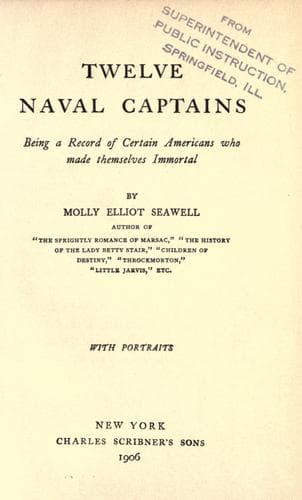
Twelve Naval Captains: Being a Record of Certain Americans Who Made Themselves ImmortalSeawell, Molly Elliot
History
Twelve Naval Captains: Being a Record of Certain Americans Who Made Themselves Immortal
Seawell, Molly Elliot
United States. Navy -- Biography
At the end of the Revolution the navy practically ceased to exist,
and Preble went into the merchant service, as so many of the officers
were forced to do. But in 1798, when the quasi war with France took
place, he re-entered the navy, which had been created anew. He was
commissioned lieutenant in 1798, and was lucky enough the very next
year to get the Essex, frigate of thirty-two guns. In her he started on
what was then the longest cruise ever made by an American man-of-war.
He went to the Indian Seas, to give convoy to a valuable fleet of
merchant vessels engaged in the China and India trade, and which were
liable to be attacked by French cruisers. He had no opportunity to
distinguish himself especially in this duty, although he took care of
the ships and got them all safely to New York. Soon afterward, the
United States and France having come to terms, Preble went ashore and
remained for two years. His health was bad in the beginning, but being
much improved, in 1803 he reported for duty, and was assigned to the
Constitution, forty-four guns, then preparing for a Mediterranean
cruise.
At that time the relations of the United States with the piratical
powers of the Barbary coast were most unsatisfactory. After years
of submission to their exactions,--a submission which seems almost
incredible now,--the United States government determined to do in
the end what it should have done in the beginning. This was to send
a powerful squadron to attack these pirates of the land as well as
the sea, and to force them to respect the persons and liberties of
Americans. Preble was given the command of this squadron, with orders
to punish Algiers, Morocco, Tunis, and especially Tripoli, so that
it would not soon be forgotten. He hoisted the broad pennant of a
commodore on the Constitution, and had under him the Philadelphia,
a heavy frigate of thirty-eight guns, and five small vessels,--the
Enterprise, Argus, Nautilus, Vixen, and Siren. It was a remarkable
squadron in many ways. The Constitution was probably the heaviest
frigate afloat, and able to withstand a cannonade as well as any
line-of-battle ship. In Preble she had a commander worthy of her.
Public-domain text, read in full here on John Shaqi.
Reviews
Reviews
No reviews yet
Be the first to share your thoughts on this work.
Join the Discussion
Join the discussion
Sign in to leave a comment or review.
Sign InorCreate an account