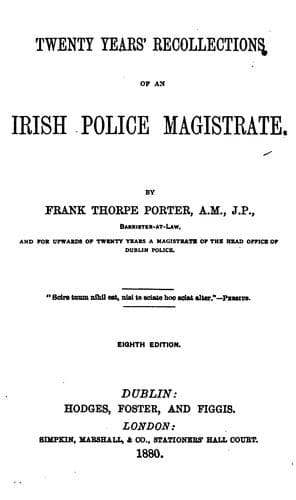
Twenty Years' Recollections of an Irish Police Magistrate — John Shaqi
Twenty Years' Recollections of an Irish Police MagistratePorter, Frank Thorpe
History
Twenty Years' Recollections of an Irish Police Magistrate
Porter, Frank Thorpe
Crime -- Ireland; Criminals -- Ireland; Ireland -- Social life and customs; Porter, Frank Thorpe, 1801-1882
I shall now advert to another Police magistrate whose name I need not
refrain from mentioning, inasmuch as although his unpopularity was
unparalleled, his name has never been associated with any imputation of
a dishonourable or debasing tendency, such as was manifested in
reference to Gonne's watch. Henry Charles Sirr was for many years
Town-Major of Dublin; and through the insurrection of 1798, and during
the outbreak of 1803, he was peculiarly energetic and most unscrupulous
in the exercise of his powers as a magistrate of Police, in which
capacity he continued until his death in 1841. He was detested by all
those to whose opinions he was opposed, and whose designs and acts he
was engaged in repressing or punishing. He was not respected by those of
a contrary tendency; for he unnecessarily and continually engaged
personally in enquiries, searches, and arrests, which a proper
appreciation of his magisterial position would have induced him to leave
to his subordinates. He was accustomed, during the insurrectionary
times, to traverse the streets of Dublin or the suburbs, with some
special attendants following at a short distance. He carried pistols,
and was also provided with a short heavy bludgeon. If a suspicion
crossed his mind in reference to any person whom he casually met, his
usual practice was to knock the individual down, and then to ascertain
if he had secured the right man. He was of considerable although
indirect advantage to his colleagues and successor; for, during his
official career, the acts of his colleagues, if of an unpopular
tendency, were attributed to the example he afforded, or to his supposed
suggestions. His successor was judged by the contrast, and his faults
were considered as venial mistakes, whilst the Major's acts were only
remembered to be stigmatized as wilful misdeeds. His courage has been
doubted, but the imputation of cowardice is not fairly sustained. It
arises from the prejudice which satisfied itself that he could not
possess any good quality. His conduct at the apprehension of Lord Edward
Fitzgerald did not evince either courage or cowardice. He entered the
room after the conflict had commenced, and fired the fatal shot, in all
probability, to save the life of his associate. He frequently, and
without any necessity, risked his personal safety, and there is no sound
reason for believing that he was of a pusillanimous nature.
Public-domain text, read in full here on John Shaqi.
Reviews
Reviews
No reviews yet
Be the first to share your thoughts on this work.
Join the Discussion
Join the discussion
Sign in to leave a comment or review.
Sign InorCreate an account