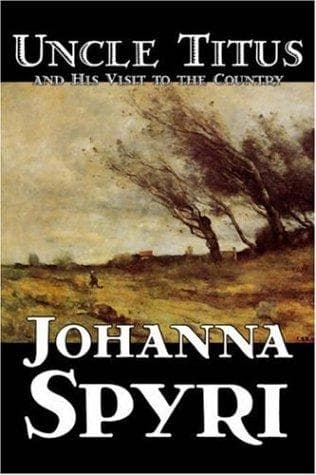
Uncle Titus and His Visit to the CountrySpyri, Johanna
General
Uncle Titus and His Visit to the Country
Spyri, Johanna
Authors -- Juvenile fiction; Country life -- Juvenile fiction; Orphans -- Juvenile fiction; Switzerland -- Juvenile fiction
Trine was sent over to the widow's house, to inquire whether it was really
a child that had been hit by the arrow, and whether it was badly hurt.
Mrs. Kurd told Trine the whole story, and that the doctor had said, "We
trust no serious harm is done," and that he would come again the next day.
Trine carried this report back to her mistress, and Mrs. Birkenfeld was
very much relieved; for her first fear had been that the child's eye might
have been hit, even if no mortal wound had been inflicted, and she was
thankful to find that things were no worse.
CHAPTER VII.
LONG-WISHED-FOR HAPPINESS.
The next morning, Mrs. Birkenfeld went early to the widow's house, where
she was most cordially received; for she as well as her friend Lili had
been a favorite pupil of Mrs. Kurd's husband. What pleasure the ardent
teacher had taken in these pupils, and what success he had had in teaching
them! He had never been tired of talking about it, and his wife had never
forgotten it.
Mrs. Birkenfeld was shown into the sitting-room, where Mrs. Kurd insisted
on her taking a seat, saying that she had much to tell her, for she had
not seen her before since she had had the strangers from Karlsruhe in her
house. There was a great deal to say about them and especially about the
accident of the day before. When the widow had talked herself out, Mrs.
Birkenfeld asked if she could speak to the lady, and to the little girl
who had been hurt.
Mrs. Kurd carried the message to Mrs. Ehrenreich, who came directly,
followed by Dora, who wore a thick bandage upon her arm, and looked very
pale and delicate. After the first greetings, Mrs. Birkenfeld took Dora's
hand tenderly in her own, and inquired with sympathy about the wound. She
then turned to Aunt Ninette and told her how deeply she regretted the
accident, and inquired in a friendly way after her health and that of Mr.
Ehrenreich. Aunt Ninette lost no time in giving her full particulars of
her husband's illness; how he had sadly needed fresh country air, and how
she had made inquiries for a quiet secluded spot, and had at last chosen
this very place; how he had to keep the windows shut tight, because he
could not bear the least sound when he was writing, and therefore he never
got any fresh air after all; and how anxious she was all the time, lest
the vertigo instead of being cured by his being here, should come on worse
than ever.
"I am very sorry indeed, that Mr. Ehrenreich should suffer from my
children's noise;" said Mrs. Birkenfeld, understanding at once the state
of the case, "if Mr. Ehrenreich does not walk out at all, he certainly
ought to have an unusually airy place to work in. I have an idea; quite at
the farthest end of our garden, away from the house, and from the
frequented part of the grounds, stands a cool summer house, with seats and
a table. If Mr. Ehrenreich would use that for his study, I would direct
the children to keep entirely away from that part of the garden."
Public-domain text, read in full here on John Shaqi.
Reviews
Reviews
No reviews yet
Be the first to share your thoughts on this work.
Join the Discussion
Join the discussion
Sign in to leave a comment or review.
Sign InorCreate an account