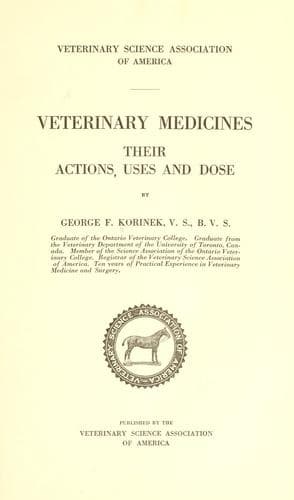
Veterinary Medicines, Their Actions, Uses and DoseKorinek, George Franklyn
Science
Veterinary Medicines, Their Actions, Uses and Dose
Korinek, George Franklyn
Veterinary drugs
ACTION AND USES.--Gentian is a pure bitter, and is prescribed as a
stomachic and tonic for all classes of animals. Gentian improves the
appetite and general tone. In atonic indigestion it is particularly
useful amongst young animals, and in such cases is often conjoined with
ginger and sodium bicarbonate. In relaxed and irritable states of the
bowels and where intestinal worms are suspected, after administration of
a laxative, gentian and dilute hydrochloric acid are of service. For
horses suffering from simple catarrh few combinations are more effectual
than an ounce of powdered gentian, two drachms potassium nitrate with
two ounces of magnesium sulphate, dissolved in a pint of linseed tea,
repeated morning and night. Where more general tonic effects are sought,
iron sulphate is alternated with the gentian and salines. Gentian proves
an excellent stomachic and stimulating tonic in influenza and other
epizootics, helps convalescence from exhausting disorders and is a
useful restorative for horses, overworked or suffering from loss of
appetite or slight cold. The powdered gentian should be added to aloes
when given in full cathartic doses to horses.
HYDRARGYRI CHLORIDUM CORROSIVUM--CORROSIVE MERCURIC CHLORIDE--BICHLORIDE
OF MERCURY--CORROSIVE SUBLIMATE
ORIGIN.--Bichloride of mercury is obtained as a sulphate by heating a
mixture of mercuric sulphate, sodium chloride and a little black oxide
of manganese.
PROPERTIES.--Heavy, colorless masses; soluble one in sixteen of water,
one in three of alcohol; hydrochloric acid or muriate of ammonia
increases its solubility.
ACTIONS.--It is a corrosive, irritant poison; it is occasionally
prescribed as an alterative, antiseptic and hepatic stimulant; repeated
doses or long continued produce mercurialism. Externally, it is used as
an antiseptic, astringent, caustic and parasiticide. It is a most
powerful antiseptic when five parts of tartaric acid are added to one
part of bichloride of mercury, which prevents the formation of insoluble
albuminates of mercury in the tissues which checks any further action of
the drug. Hydrochloric acid equal parts serves the same purpose.
Public-domain text, read in full here on John Shaqi.
Reviews
Reviews
No reviews yet
Be the first to share your thoughts on this work.
Join the Discussion
Join the discussion
Sign in to leave a comment or review.
Sign InorCreate an account