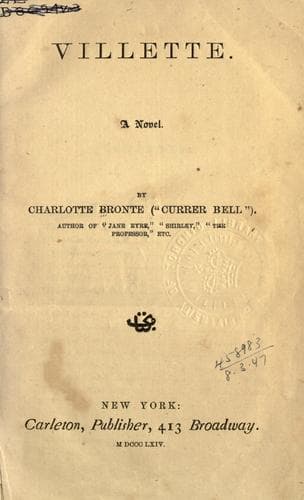
Autobiographical fiction; British -- Belgium -- Fiction; Brussels (Belgium) -- Fiction; Love stories; Women teachers -- Fiction
I ask this question now, but I could not ask it then. I could say
nothing whatever; not possessing a phrase of _speaking_ French: and it
was French, and French only, the whole world seemed now gabbling around
me. _What_ should I do? Approaching the conductor, I just laid my hand
on his arm, pointed to a trunk, thence to the diligence-roof, and tried
to express a question with my eyes. He misunderstood me, seized the
trunk indicated, and was about to hoist it on the vehicle.
“Let that alone—will you?” said a voice in good English; then, in
correction, “Qu’est-ce que vous faîtes donc? Cette malle est à moi.”
But I had heard the Fatherland accents; they rejoiced my heart; I
turned: “Sir,” said I, appealing to the stranger, without, in my
distress, noticing what he was like, “I cannot speak French. May I
entreat you to ask this man what he has done with my trunk?”
Without discriminating, for the moment, what sort of face it was to
which my eyes were raised and on which they were fixed, I felt in its
expression half-surprise at my appeal and half-doubt of the wisdom of
interference.
“_Do_ ask him; I would do as much for you,” said I.
I don’t know whether he smiled, but he said in a gentlemanly tone—that
is to say, a tone not hard nor terrifying,—“What sort of trunk was
yours?”
I described it, including in my description the green ribbon. And
forthwith he took the conductor under hand, and I felt, through all the
storm of French which followed, that he raked him fore and aft.
Presently he returned to me.
“The fellow avers he was overloaded, and confesses that he removed your
trunk after you saw it put on, and has left it behind at Boue-Marine
with other parcels; he has promised, however, to forward it to-morrow;
the day after, therefore, you will find it safe at this bureau.”
“Thank you,” said I: but my heart sank.
Meantime what should I do? Perhaps this English gentleman saw the
failure of courage in my face; he inquired kindly, “Have you any
friends in this city?”
“No, and I don’t know where to go.”
There was a little pause, in the course of which, as he turned more
fully to the light of a lamp above him, I saw that he was a young,
distinguished, and handsome man; he might be a lord, for anything I
knew: nature had made him good enough for a prince, I thought. His face
was very pleasant; he looked high but not arrogant, manly but not
overbearing. I was turning away, in the deep consciousness of all
absence of claim to look for further help from such a one as he.
“Was all your money in your trunk?” he asked, stopping me.
How thankful was I to be able to answer with truth—“No. I have enough
in my purse” (for I had near twenty francs) “to keep me at a quiet inn
till the day after to-morrow; but I am quite a stranger in Villette,
and don’t know the streets and the inns.”
“I can give you the address of such an inn as you want,” said he; “and
it is not far off: with my direction you will easily find it.”
Public-domain text, read in full here on John Shaqi.
Reviews
Reviews
No reviews yet
Be the first to share your thoughts on this work.
Join the Discussion
Join the discussion
Sign in to leave a comment or review.
Sign InorCreate an account