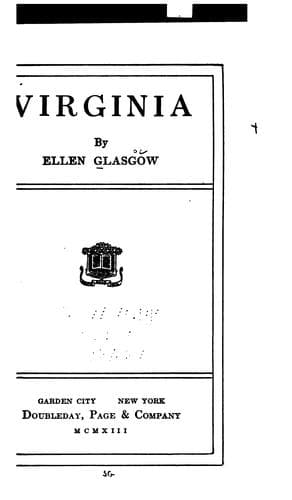
Marriage -- Fiction; Virginia -- Fiction; Wives -- Fiction; Women -- Fiction
He drew out his latchkey as he spoke, for they had reached the corner of
Bolingbroke Street, and the small dingy house in which they lived was
only a few doors away. As they passed between the two blossoming
oleanders in green tubs on the sidewalk, James glanced up at the flat
square roof, and observed doubtfully, "You'll be getting out of this old
place before long now, I reckon."
"Oh, someday, someday," answered Cyrus. "There'll be time enough when
the market settles and we can see where the money is coming from."
Once every year, in the spring, James asked his father this question,
and once every year he received exactly the same answer. In his mind,
Cyrus was always putting off the day when he should move into a larger
house, for though he got richer every week, he never seemed to get quite
rich enough to commit himself to any definite change in his
circumstances. Of course, in the nature of things, he knew that he ought
to have left Bolingbroke Street long ago; there was hardly a family
still living there with whom his daughter associated, and she complained
daily of having to pass saloons and barber shops whenever she went out
of doors. But the truth was that in spite of his answer to James's
annual question, neither of them wanted to move away from the old home,
and each hoped in his heart that he should never be forced into doing
so. Cyrus had become wedded to the house as a man becomes wedded to a
habit, and since the clinging to a habit was the only form of sentiment
of which he was capable, he shrank more and more from what he felt to be
the almost unbearable wrench of moving. A certain fidelity of purpose,
the quality which had lifted him above the petty provincialism that
crippled James, made the display of wealth as obnoxious to him as the
possession of it was agreeable. As long as he was conscious that he
controlled the industrial future of Dinwiddie, it was a matter of
indifference to him whether people supposed him to be a millionaire or a
pauper. In time he would probably have to change his way of living and
put an end to his life-long practice of saving; but, meanwhile, he was
quite content to go on year after year mending the roof and the chimneys
of the old house into which he had moved the week after his marriage.
Entering the hall, he hung his hat on the walnut hat-rack in the dark
corner behind the door, and followed the worn strip of blue and red
oilcloth which ran up the narrow staircase to the floor above. Where the
staircase bent sharply in the middle, the old-fashioned mahogany
balustrade shone richly in the light of a gas-jet which jutted out on a
brass stem from the wall. Although a window on the upper floor was
opened wide to the sunset, the interior of the house had a close musty
smell, as if it had been shut up, uninhabited, for months. Cyrus had
never noticed the smell, for his senses, which were never acute, had
been rendered even duller than usual by custom.
Public-domain text, read in full here on John Shaqi.
Reviews
Reviews
No reviews yet
Be the first to share your thoughts on this work.
Join the Discussion
Join the discussion
Sign in to leave a comment or review.
Sign InorCreate an account